Most travellers who visit Xi'an come for the Terracotta Army, the city wall and the Muslim Quarter. Fewer know that less than an hour's drive from the city centre there is a very different kind of artistic landmark - one that is still being painted, still being taught, and still rooted in the fields and villages where it began.
Huxian farmer painting - now more precisely called Huyi District farmer painting, following the district's 2017 administrative renaming - is one of the most distinctive folk art movements to emerge from modern China. It is not a museum relic. It is a living tradition practised by farmers, villagers, retired teachers and young people who paint in kitchens, courtyards and community studios, using saturated colour, dense patterning and an unmistakably optimistic visual language that has almost no equivalent in Western folk art.
This article does two things. First, it introduces the tradition itself: where it came from, what makes it visually unique, what its painters actually depict, and why it matters. Second, it explains how PandaStudyTour's visual arts programmes can take your group there - not as a five-minute photo stop, but as a genuine encounter with working artists, a hands-on painting session and a conversation about what rural Chinese culture looks like from the inside.
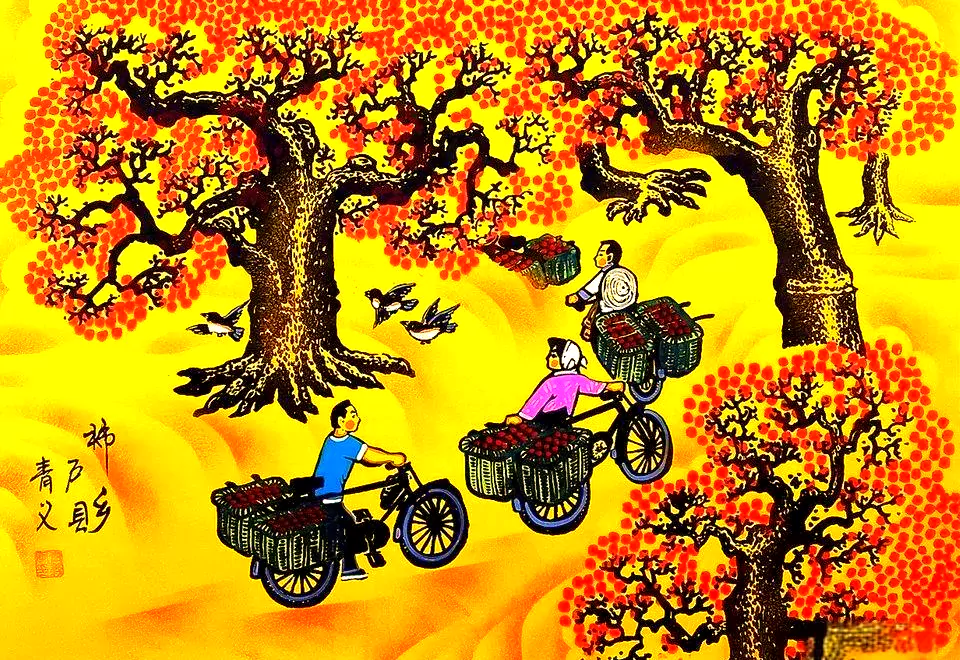
At its simplest, Huxian farmer painting is the work of amateur and semi-professional artists from farming communities in Huyi District, southwest of Xi'an in Shaanxi Province, who paint scenes of rural life, festivals, harvests, family routines and village customs in a highly decorative, brilliantly coloured style.
At a deeper level, it is a genuine artistic movement with a history of more than seventy years. It grew out of a mid-twentieth-century effort to bring art training to rural communities, when local cultural workers began teaching basic drawing, colour theory and composition to farmers who had never held a proper brush. What emerged was not imitative amateur work but something with its own logic — a visual language that borrowed from paper-cutting, embroidery, New Year woodblock prints, temple murals and shadow puppetry, then pushed all of it into a bolder, flatter, more crowded and more joyful register.
The style is instantly recognisable once you have seen a few examples:
There is no attempt at realism, and no need for one. The paintings are closer to visual storytelling than to documentary recording.
Huyi District - historically Huxian County - sits on the plain south-west of Xi'an, beneath the Qinling Mountains. It is farming country: wheat, corn, vegetables, orchards, small villages strung along irrigation channels. It is also, importantly, close enough to Xi'an to be within reach of the city's cultural institutions, art teachers and exhibition networks, which is one of the reasons the farmer painting movement took hold so strongly here rather than somewhere more remote.
The tradition's formative period was the 1950s and 1960s, when art-training campaigns reached rural counties across China. Local organisers taught farmers basic skills, organised exhibitions, and encouraged them to paint their own lives rather than imitate professional academic painting. By the 1970s and 1980s, Huxian had developed a recognisable collective identity, with a group of gifted painters — Li Fenglan and Liu Zhide are among the best-known names — producing works that were shown in provincial exhibitions and then, remarkably, abroad.
From the late 1970s onward, Huxian farmer paintings travelled to exhibitions in Europe, North America and Asia. Cultural institutions began describing the county as a "hometown of modern Chinese farmer painting", and in 2008 the tradition was inscribed on China's national intangible cultural heritage list. Today Huxian farmer painting is treated as one of Shaanxi's signature folk-art forms, alongside Xi'an drum music, shadow puppetry and Shaanxi paper cutting.
The subject matter is what makes these works so valuable as a cultural record. You will see:
Agricultural life. Planting, hoeing, irrigation, harvesting, threshing, drying grain on the road, driving livestock. Machines appear in later works — tractors, pumps, trucks — showing the mechanisation of rural labour across decades.
Festivals and ceremonies. Spring Festival preparations, dumpling-making, lantern displays, weddings, births, temple fairs, lion dances, opera stages lit at night.
Family and domestic interiors. Grandmothers and grandchildren, kitchens, sewing, weaving, quilting, children doing homework by lamplight.
Village social life. Village meetings, literacy classes, health campaigns, sports days, film screenings in the open air — small social histories painted by the people who lived them.
Nature and seasons. Orchards in blossom, autumn maize, lotus ponds, beehives, fish ponds, the Qinling foothills.
Modern themes. New rural construction, tourism, e-commerce in villages, rural revitalisation — proof that the tradition is not frozen in the past but keeps absorbing whatever is actually happening in the countryside.
For an international visitor, this is the closest thing China offers to a self-portrait of its rural population, painted without a professional filter.
There are three reasons Huxian farmer painting deserves a place on a serious cultural itinerary.
First, it is authentic and contemporary, not staged. The painters are not performers. Many of them have been painting for decades; some are the second or third generation in a family of farmer artists. Their work is sold, exhibited, taught and collected. When you visit a studio, you are not watching a demonstration arranged for tourists - you are standing in someone's working space.
Second, it is visually unlike anything else in China. A group that has already seen imperial architecture, Buddhist sculpture and literati ink painting will find this work genuinely surprising: loud, pattern-dense, crowded, funny, warm, unapologetically decorative. It is a useful corrective to the assumption that "Chinese art" means muted ink wash and empty space.
Third, it opens a conversation. Farmer painting is about how rural communities see themselves. That conversation — about land, labour, family, migration, modernisation, and what is gained and lost - is one of the most interesting conversations you can have in China today, and it is much easier to have it in a village studio than in a lecture hall.
Knowing that Huxian farmer painting exists is one thing. Getting a group of fifteen or thirty people into a working studio, with interpretation, structured activities and a schedule that actually holds together, is another. This is where we come in.
Exhibition and museum visits. We organise guided visits to the Huxian farmer painting exhibition venues in Huyi District, with a bilingual walkthrough that explains the movement's history, the visual grammar of the style, and the individual works on display. Rather than a list of dates and titles, the briefing is built around how to read these paintings - what the patterns mean, why perspective is abandoned, how colour is chosen.
Meetings with working artists. We arrange studio visits with practising farmer painters, including artists who have exhibited internationally. Groups see works in progress, learn how a painting is built from first sketch to final colour block, and hear directly from the artist about their own history, training and subject choices. Conversation is interpreted, not summarised.
Hands-on painting workshops. This is the part participants remember. In a guided session of two to three hours, a local artist introduces the materials, explains how the style handles composition and colour, and then leads the group through a simple painting of their own - a village scene, an animal, a festival motif. Beginners are genuinely welcome; the style is forgiving of unsteady hands, which is precisely one of its charms. Participants take their work home.
Paper-cutting and textile crossover sessions. Because the style borrows heavily from paper cutting and embroidery, we often pair a painting workshop with a paper-cutting demonstration or a visit to a local embroidery or textile workshop, so the group sees where the visual vocabulary came from.
School and student exchanges. For educational groups, we can arrange exchange sessions with local schools that teach farmer painting as part of their art curriculum, letting visiting students paint alongside local students. This is one of the most requested formats for school and university groups.
Cultural context add-ons. A Huxian visit sits naturally beside other Shaanxi cultural content: village walks, local market visits, a farmhouse meal, shadow puppetry, and of course the Terracotta Army and Xi'an city sights. We build the day so that the folk art is not an isolated stop but part of a coherent picture of the region.
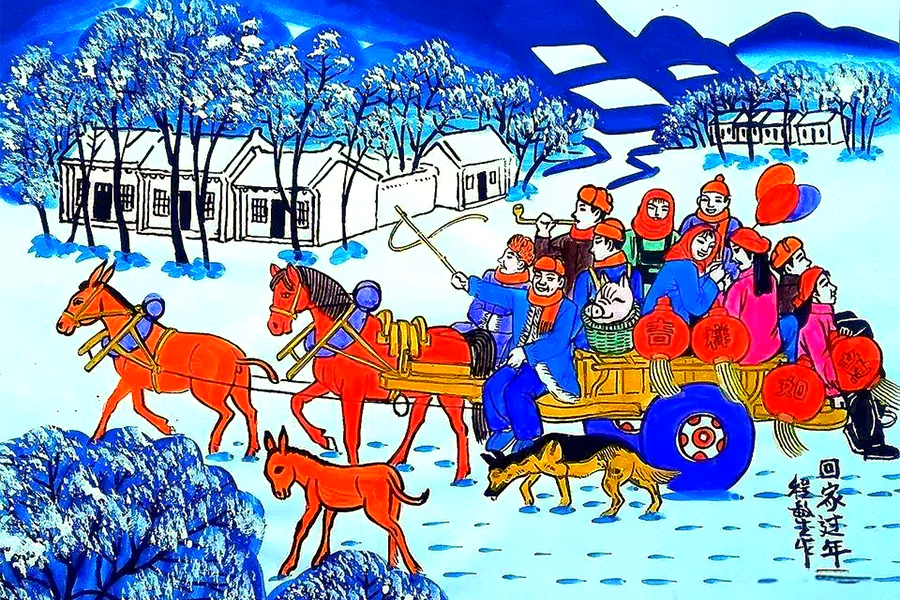
We design three typical formats:
Half-day cultural visit. Exhibition venue plus one artist studio, with a short demonstration and Q&A. Ideal for groups with a tight schedule who want the tradition explained properly.
Full-day immersion. Exhibition visit, two artist studios, a farmhouse lunch, and a two-hour painting workshop. This is our most popular format and works well for adult cultural groups, art societies and university cohorts.
Multi-day arts residency. Two to three days based in Huyi District, combining painting workshops, paper cutting, embroidery or textile sessions, school exchange, village walks, and a final group exhibition and critique of participants' own work. We run this format for art schools, teacher-training groups and specialist cultural tours.
Every format is adjustable for group size, age, fitness and language needs, and every programme is quoted transparently with inclusions listed.
Genuine local access. Our value here is relationships. We work with artists, studios, exhibition venues and local schools directly, which means visits are arranged with the people who actually paint, not with a booking desk.
English-first delivery with technical accuracy. Art vocabulary is specific - composition, palette, negative space, ornament, folk idiom. Our guides and interpreters are briefed on the terminology in advance so that explanation does not flatten into "very beautiful, very old".
Programmes built around learning outcomes. For academic groups, we can align workshop content and discussion topics with a course theme: folk art and modernity, rural visual culture, colour theory in non-Western traditions, intangible heritage and tourism. We provide pre-trip reading notes and a post-trip summary.
Logistics that hold. Transport from Xi'an, meals that accommodate dietary requirements, workshop materials prepared in advance, adequate rest breaks, and a programme manager who handles the details on the day so that the group's time goes into the art rather than into waiting.
Respectful cultural framing. We brief participants on how to behave in a working studio: asking before photographing, not touching unfinished work, understanding that the artist's time is being given voluntarily. Access depends on goodwill, and we protect it.
Where it is. Huyi District is roughly 40–60 minutes by road from central Xi'an, depending on traffic and the specific village.
When to go. Spring and autumn are the most comfortable seasons; winter visits are possible but studios are cold. Weekdays are calmer than weekends and public holidays.
Who it suits. Cultural travellers, art societies, university and school groups, teacher-training cohorts, photographers, and families with older children. No prior painting experience is required at any point.
What to bring. Comfortable shoes, clothing you do not mind getting pigment on, and a camera for the exhibition areas (studio photography is by permission).
Language. All PandaStudyTour programmes are delivered in English, with bilingual support for workshops and artist conversations.
Is Huxian farmer painting the same as traditional Chinese ink painting?
No. It is a separate folk tradition using water-borne opaque colour on paper, with flat composition, bold outlines and heavy ornamentation. It owes more to paper cutting, embroidery and New Year prints than to literati brush painting.
Do we need artistic skill to join a workshop?
No. The style rewards boldness rather than precision, and instructors teach a simple, repeatable method. Most participants finish a recognisable painting in two to three hours.
Can we buy original works?
Often yes, directly from artists at their studios, subject to availability and price. We can advise on reasonable pricing and on packing or shipping.
How far in advance should we book?
For studio visits and workshops, two to three months is comfortable. Larger groups or multi-day residencies benefit from three to six months.
Can this be combined with other art content?
Yes - most naturally with calligraphy, paper cutting, shadow puppetry and Shaanxi folk crafts. Our Calligraphy, Painting and Visual Arts programmes are built precisely to combine these strands within one coherent itinerary.
Huxian farmer painting is one of those subjects that sounds minor on paper and turns out to be unforgettable in person. It is loud, patterned, generous, funny, occasionally clumsy, and completely sincere — a body of work made by people painting their own lives rather than someone else's idea of beauty.
If your group is travelling through Xi'an and has room for one more cultural layer beyond the imperial monuments, this is the one we would recommend. PandaStudyTour arranges exhibition visits, studio meetings with working artists, hands-on workshops and school exchanges in Huyi District, and we can build it into a half-day, a full day, or a multi-day arts residency depending on what your group actually needs.
If you would like a sample schedule, a costed outline for your group size, or a look at how a Huxian visit fits into a wider Shaanxi arts itinerary, our visual arts team can prepare it for you — starting from your objectives rather than from a fixed template.
