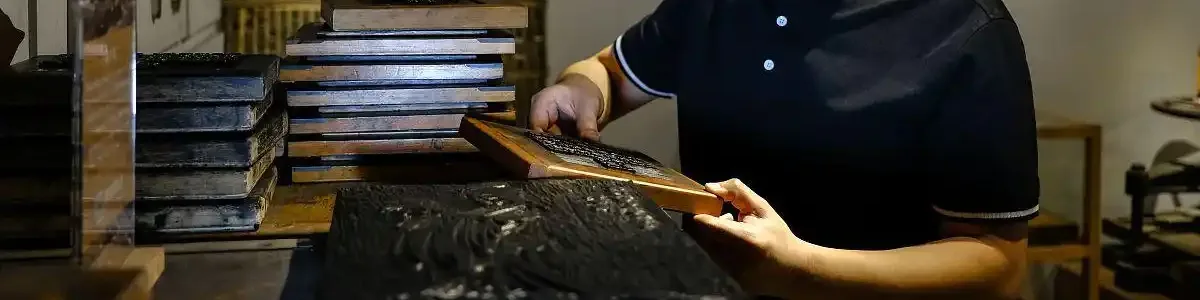
Destinations: In the Footsteps of the Hui Merchants
For more than four centuries, a mountain region in what is now southern Anhui produced one of the most powerful merchant networks in the Chinese empire. With too little farmland and too many mouths to feed, the clans of ancient Huizhou sent their sons down the rivers to trade - in salt, tea, timber, lacquer, ink and grain - and brought their fortunes home as stone archways, ancestral halls, carved mansions and schools. The Hui merchants, or Huishang, were said to be so ubiquitous that "no town can prosper without a Hui merchant" (wu Hui bu cheng zhen).
This seven-day PandaStudyTour program is designed for international students, university groups and curious independent travelers who want to understand how commerce actually worked in imperial China: how credit was kept without banks, how family clans underwrote risk, how merchant money was converted into social status, and how a trading culture shaped the villages we still walk through today. Every stop on the route is a classroom - an ink workshop where you press your own ink cake, a merchant mansion whose beams are carved with entire operas, a stone weir where salt boats once departed, and a two-hour stretch of the old Hui–Hang trade road that connected this mountain basin to Hangzhou.
HIGHLIGHTS
Day 1 - Arrival in Huangshan City (Tunxi): Setting the Scene
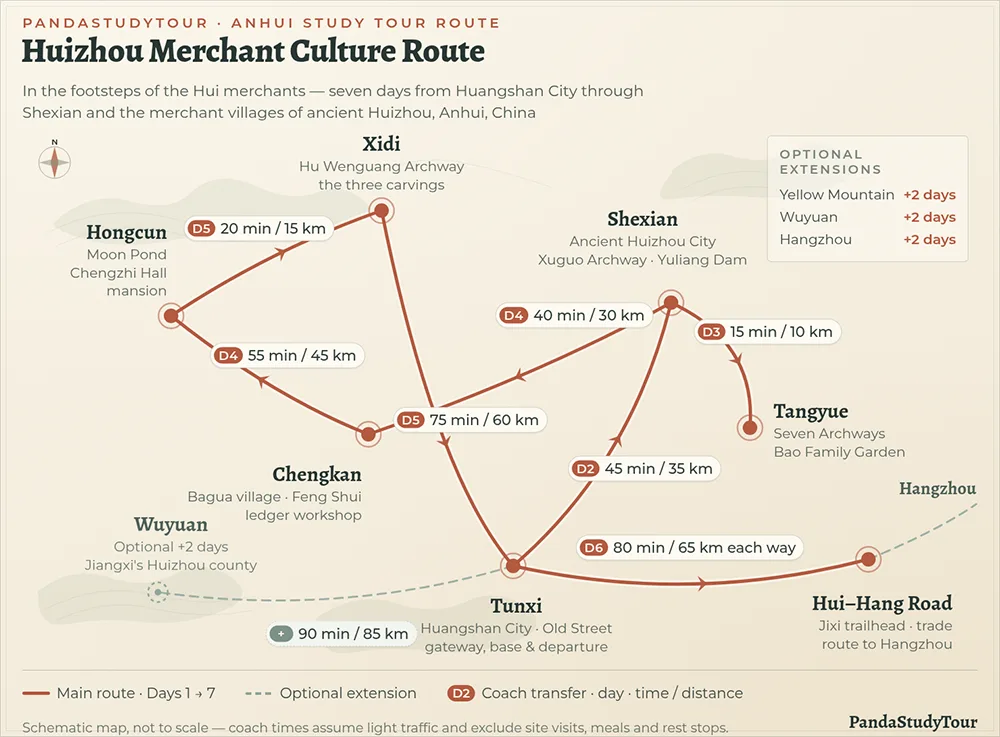
Arrive at Huangshan Tunxi International Airport or Huangshan North Railway Station and transfer to your hotel in the old trading quarter. In the late afternoon, walk Tunxi Old Street, a Song-dynasty street plan lined with Qing-era shopfronts, tea warehouses and ink counters - the commercial face of Huizhou today. Visit Wan Cui Lou, a private four-floor museum of Huizhou furniture, ink, ceramics and merchant documents, for a first orientation. After dinner, a 45-minute opening lecture: "Why a mountain basin became a trading power" - land scarcity, clan migration, the salt franchise system and the Hui camel spirit of endurance. Learning objective: understand the geographic and demographic pressures that pushed Huizhou into commerce.
Day 2 - Huizhou Culture Museum and the Merchants' Capital, Shexian
Morning at the Chinese Huizhou Culture Museum in Tunxi, whose galleries trace clan registers, trade goods, merchant letters and the "merchants but fond of learning" ideal (jia er hao ru). After lunch, drive to Shexian, the administrative heart of ancient Huizhou. Walk the old city: the Xuguo Stone Archway, the restored Huizhou Prefectural Office, the granite lane of Dou Shan Jie where merchant families built their town houses, and Yuliang Dam on the Lianjiang River, the shipping point for goods bound downstream. Evening: a Hui cuisine tasting dinner with a short talk on how traveling merchants carried flavors between regions. Learning objective: connect trade routes, official administration and the physical fabric of a merchant town.
Day 3 - Ink, Inkstone and Social Capital
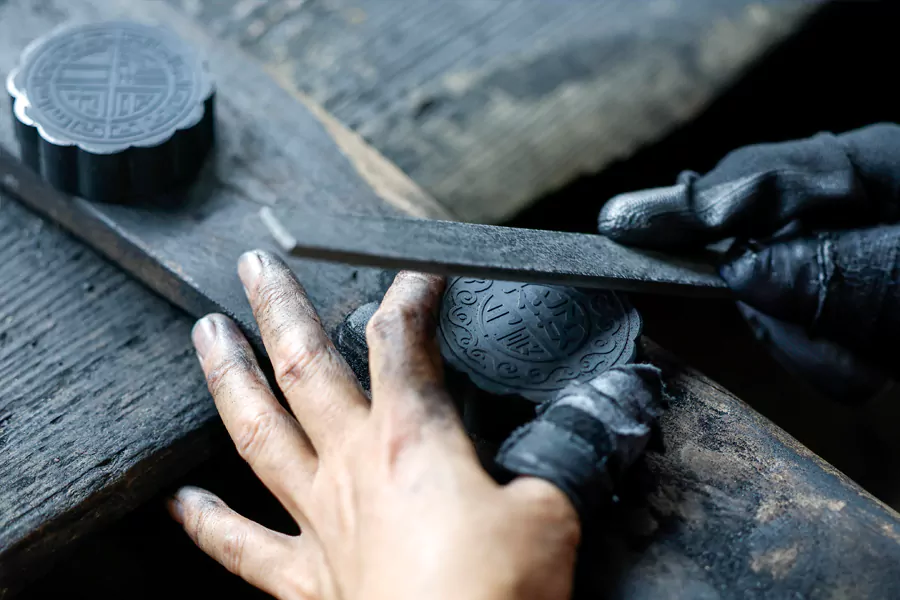
This day is devoted to the goods Hui merchants sold and the status they bought. Morning at the Hu Kaiwen Ink Workshop in Shexian: mix pine soot with glue, press the paste into a mould, gild the characters, and take home your own ink cake. Then a She inkstone carving studio, where you learn how Longwei stone is cut, polished and engraved. Afternoon at the Tangyue Archway Complex and the adjacent Bao Family Garden. Standing beneath the seven archways, discuss how merchant clans converted commercial profit into moral reputation - endowing schools, bridges, granaries and chastity memorials - and why that investment was essential to a family's long-term standing. Learning objective: analyse the economics of craft production and the conversion of wealth into social legitimacy.
Day 4 - Feng Shui, Bookkeeping and the Logic of Risk
Morning in Chengkan, a village whose lanes, ponds and door orientations were laid out according to the eight trigrams; learn how geomantic planning managed water, fire risk and clan hierarchy. Midday workshop: the Dragon Gate ledger. A local accountant and historian walk you through a simulated multi-branch trading house - capital, branches, partners, dividend calculation - using the double-entry style system Hui merchants refined centuries before modern accounting. Afternoon drive into Yixian County, with a stop at the Ming-Qing folk house museum at Qikou for architectural context. Overnight in Hongcun village, when the tour buses have gone. Learning objective: understand credit, partnership and risk-sharing in a pre-bank economy.
Day 5 - Merchant Mansions: Hongcun and Xidi
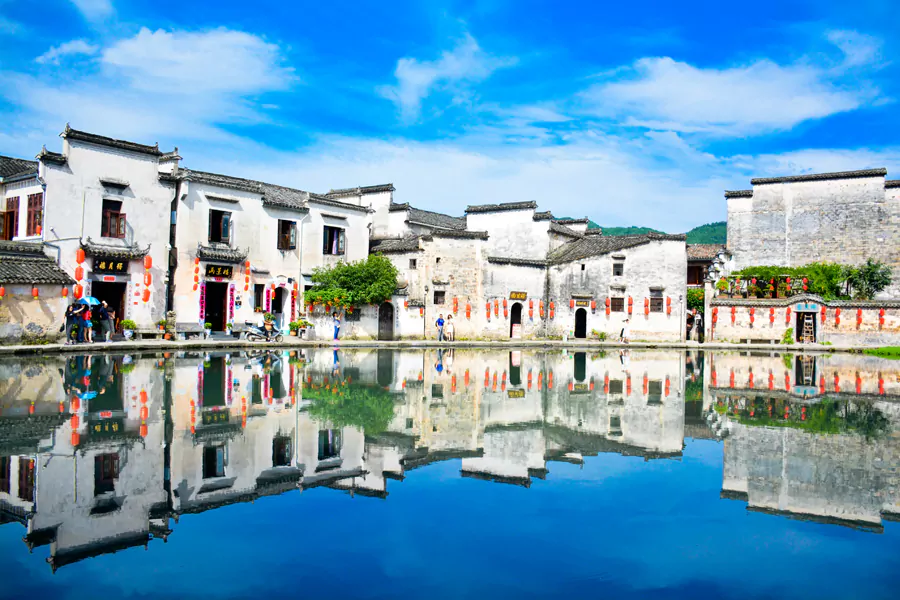
Early morning walk around Hongcun's Moon Pond and South Lake, followed by a detailed visit to Chengzhi Hall, a 60-room merchant residence built in the mid-19th century by a salt trader, whose beams and lattice panels are carved with merchants' biographies, operatic scenes and scholarly motifs. Afternoon in Xidi: the Hu Wenguang Archway, the ancestral halls, and a guided comparison of wood, brick and stone carving as a statement of taste. In the evening, a private Hui opera demonstration with a short explanation of the Four Great Anhui Troupes and their 1790 journey to the capital. Overnight in a village inn. Learning objective: read architecture as autobiography - how merchants wrote their ambitions into wood and stone.
Day 6 - Tea, Trade Routes and the Road to Hangzhou
Morning at a century-old tea house enterprise in Huangshan to trace how Hui merchants branded and exported Huangshan Maofeng, and - for groups with an interest in global trade - Keemun black tea. Then a hands-on session: pick, wither, wok-fry and roll tea leaves, and cup the results against a commercial sample. After lunch, walk a two-hour section of the Hui–Hang Ancient Road, the granite path along which porters carried tea, ink and timber to Hangzhou, with readings from merchant travel accounts along the way. Return to Tunxi in the evening; free time for independent exploration of the old street. Learning objective: follow a single commodity from bush to brand to export market, and experience the physical cost of trade.
Day 7 - Merchant Case Studies and Departure
Morning: a student-led case-study session. Small teams present their findings on one Hui merchant family - the salt magnate Hu Xueyan, the Hongcun merchant who built Chengzhi Hall, the Bao clan of Tangyue, or the tea merchant who created Maofeng - and connect it to what they observed on the road. Afterwards, a Xin'an School painting mini-workshop or free time for shopping at ink, tea and inkstone counters on Tunxi Old Street. Transfer to the airport or railway station for departure. Learning objective: synthesize field observations into an argued conclusion and present it in English.
OPTIONAL EXTENSIONS
WHAT IS INCLUDED
Six nights in heritage-style hotels and village inns with breakfast; all ground transport by private coach; English-speaking national guide and local site lecturers; all entrance fees and workshop materials; five lunches and four dinners including one Hui cuisine tasting; field notebook, reading pack and certificate of completion.
NOT INCLUDED
International and domestic flights or train tickets to and from Huangshan; Chinese visa fees; travel insurance; personal expenses; optional extensions; single-room supplement.