There are destinations you photograph, and there are destinations that quietly photograph you back. Tibet belongs to the second kind. Most travellers arrive expecting mountains, monasteries and altitude headaches. They leave carrying something stranger and more valuable - a small personal ritual they performed with their own hands, in a place where nobody was watching and nothing was performed for a camera.
That is the real reason Tibet sits on so many bucket lists. Not because the Potala Palace is beautiful (it is), not because Everest is tall (it is), but because Tibet is one of the last places on earth where a visitor is allowed to participate instead of merely observe. You can light a lamp. You can hang a flag with your family's names on it. You can take a string of beads that will sit in your pocket for the next twenty years. You can stack a stone at a mani wall that will still be there long after your flight home.
If you are still deciding whether Tibet is worth the permit paperwork and the thin air, this guide is for you. Below we explain why the plateau changes people, then walk you through the ten personal rituals you can genuinely do yourself - plus a handful of smaller "make it yours" ideas most travellers never hear about. When you are ready to plan, browse our Tibet tours to see which itineraries include these experiences.
1. The landscape resets your sense of scale. Lhasa sits at 3,650 metres. The road to Everest Base Camp crosses passes above 5,000 metres. Yamdrok Lake is a turquoise sheet of water at 4,400 metres, and Namtso is higher still. You will spend several days in a world where the horizon is simply not where your eyes expect it to be. For most visitors from lowland cities, this is the first time their own body becomes part of the journey rather than a container for it.
2. The spirituality is not staged. Unlike heritage sites that have been converted into performance, Tibetan monasteries are working institutions. Monks debate in the courtyards of Sera at dusk. Pilgrims prostrate their way along the Barkhor circuit before breakfast. Butter lamps flicker in the Jokhang from early morning until night. You are not visiting a museum of faith; you are walking through a neighbourhood where faith is the daily economy.
3. Participation is permitted - and that is rare. In most of the world's sacred places, tourists are kept behind a rope. In Tibet, if you behave respectfully, you can do what pilgrims do: offer a scarf, light a lamp, spin a wheel, add a stone, walk the kora. Foreign visitors often say the same thing afterwards - the moment they stopped taking photos and started doing something with their hands, Tibet became real.
4. It is a genuinely difficult place to reach, and that filters the crowd. Foreign travellers need a Tibet Travel Permit arranged through a licensed agency, must travel with a guide, and often need additional permits for Shigatse, Everest or the far west. This bureaucracy is annoying, but it also means the Barkhor in the morning is still full of Tibetan pilgrims rather than tour buses.
5. The plateau gives you an excuse to slow down. Altitude forces a different pace. You walk slower. You drink more water. You sit in a tea house for an hour doing nothing. Many travellers describe the days in Tibet as the calmest of their whole year - not because they meditated, but because their bodies refused to hurry.
Everything below is achievable on a standard group itinerary - usually with a guide's help for translation, but performed by you. These are not staged "tourist experiences"; they are adaptations of ordinary pilgrim practice.
In the Jokhang and in most monasteries you will find rows of small brass or glass bowls filled with yak butter or vegetable oil. Pilgrims buy a lamp, or pay to have a bowl filled, and light it as an offering for the health of family, for a deceased relative, for a safe journey, or simply as a wish for clarity.
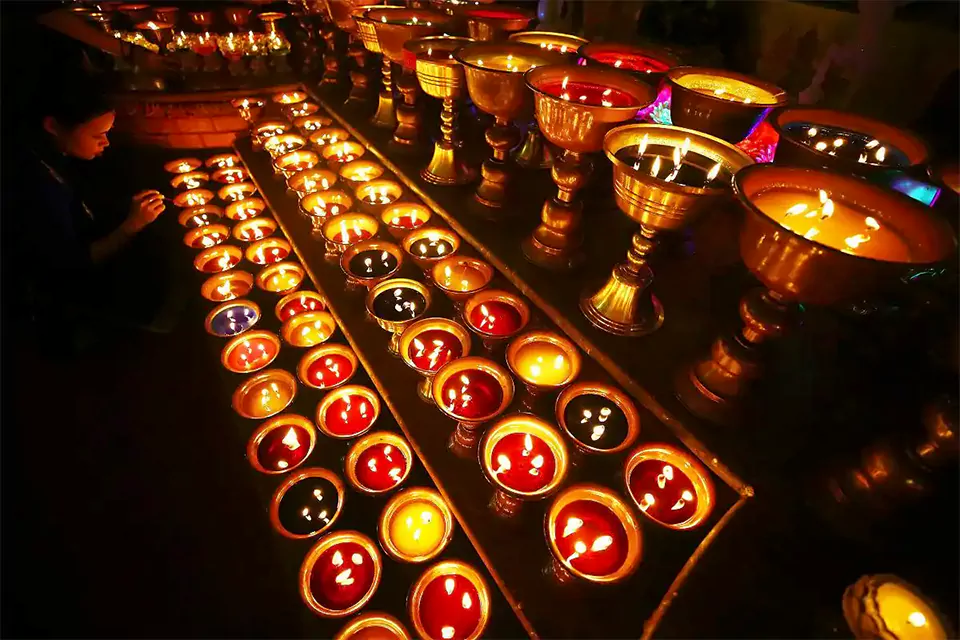
How to do it: at the Jokhang you can buy a small lamp and oil from the stalls around the Barkhor, or ask your guide to arrange a lamp offering inside the temple. The cost is trivial - usually a few yuan - and the merit is not measured in money. Fill the bowl, light it with the wick provided, place it among the others, and say quietly whatever it is you came to say.
Etiquette: never blow out a lamp, never reach across someone else's offering, never touch flame to another lamp without permission, and do not photograph pilgrims' faces at close range while they pray. If a monk is filling lamps, wait to be invited before joining.
Why it stays with you: a butter lamp burns for hours. Somewhere in Lhasa, in a hall you will never visit again, a small flame is burning because you put it there. That is a strange and durable kind of memory.
Prayer flags - lungta, "wind horse" - are printed with mantras and auspicious symbols. The five colours represent the elements: blue for sky, white for air, red for fire, green for water, yellow for earth. When the wind moves the cloth, the prayer is carried outward. Sets are commonly sold in strings of 25 (five colours repeated five times) or, for larger offerings, 108 flags - the same sacred number as the beads on a mala.
How to do it: buy a set at the Barkhor or a monastery shop. Before you hang it, ask your guide or a monk to write your family's names, or a short wish, on the cloth in Tibetan script - many shops will do this for a small fee, and it is the detail that turns a souvenir into an offering. Hang it at a mountain pass, on a hillside above a monastery, at Yamdrok Lake, or at the base of a stupa, tied to a pole or a cairn and left to the wind.
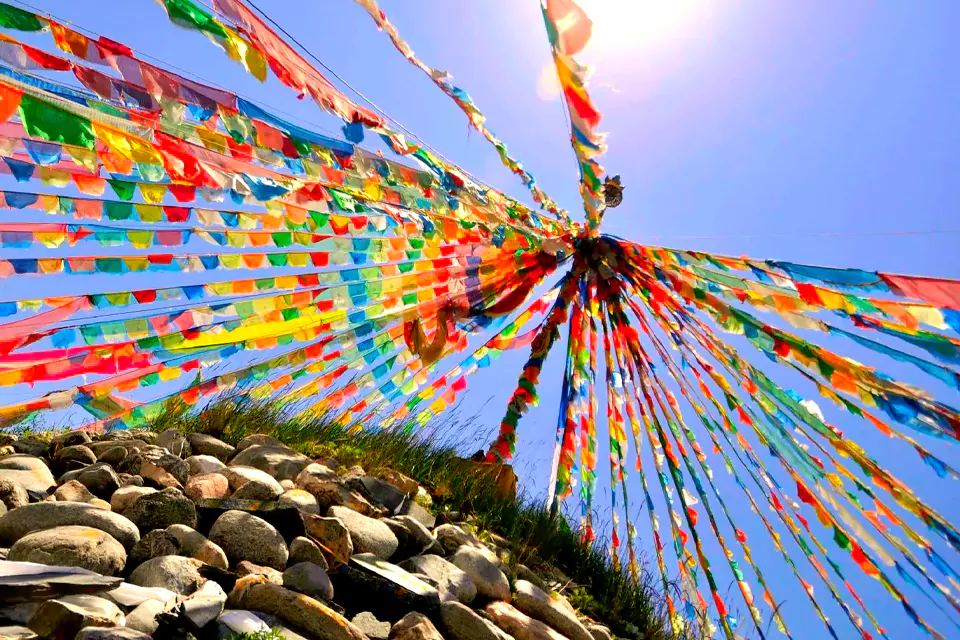
Etiquette: hang flags above the ground, never let them touch the ground while tying them, never step over or walk on fallen flags, and do not pull down old ones to make space for yours. Place new flags respectfully beside the old, or at a designated spot. Do not buy flags as a fashion item to drape on your backpack through the city - that reads as careless.
Why it stays with you: months later, someone will still be reading your prayer on that ridge.
A Buddhist mala has 108 beads plus a larger guru bead. In Tibet you will see them everywhere - turquoise and coral strung on monks' wrists, dzi-stone beads in traders' hands, bodhi seed and sandalwood in pilgrims' palms. Buying beads at the Barkhor is easy; making them yours takes one extra step.
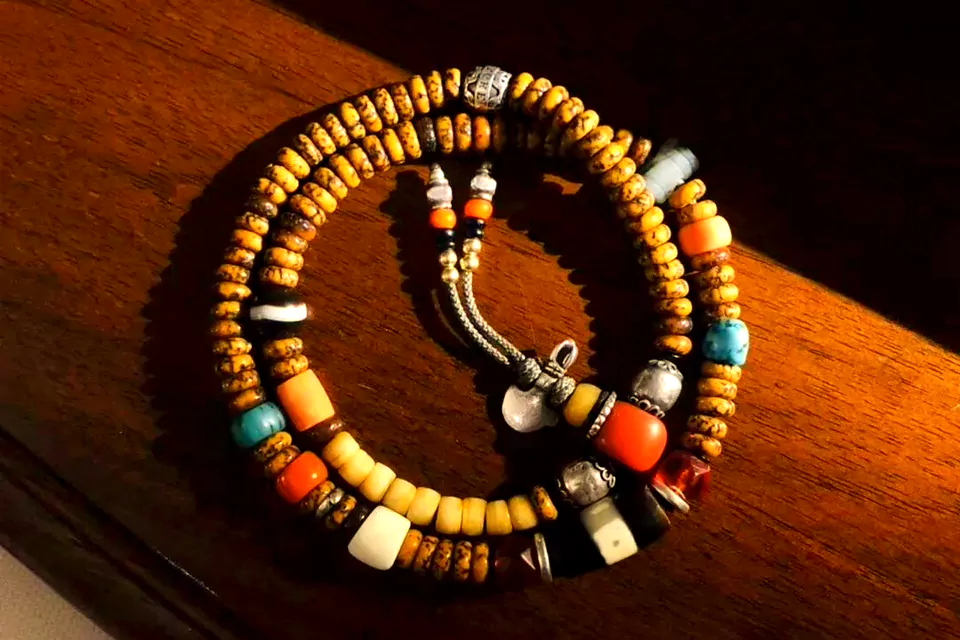
How to do it: choose the material that appeals to you rather than the most expensive one. Bodhi seed is the traditional pilgrim choice and inexpensive. Ask a monk, if the moment is right, to bless the beads - often done simply by holding them, reciting a mantra, and blowing gently on them. Some monasteries will do this for a small donation; ask your guide to enquire rather than approaching monks mid-ceremony.
Etiquette: do not place beads on the floor, do not hang them on a bedpost, treat them as an object you would not want to drop. Use your right hand to hold and count. Do not wear them purely as decoration over a business suit - if you carry them, carry them as a practice, even if your practice is only "remembering to breathe for two minutes a day".
Why it stays with you: beads outlive trips. Ten years from now, a friend will ask where they came from, and you will tell a story instead of naming a shop.
Mani stones are flat rocks carved with the six-syllable mantra, Om Mani Padme Hum. Pilgrims carve them, buy them, carry them, and add them to the long mani walls that line roads and passes across the plateau. Every stone in every wall was placed by a person with a reason.
How to do it: buy a carved stone at the Barkhor, at a monastery entrance, or from roadside vendors near a mani wall. Some workshops will carve a name or a short dedication for you. At the wall, find a gap, place your stone with both hands, and add it on top rather than knocking anything down. Your guide can explain where adding is welcome and where a wall is protected.
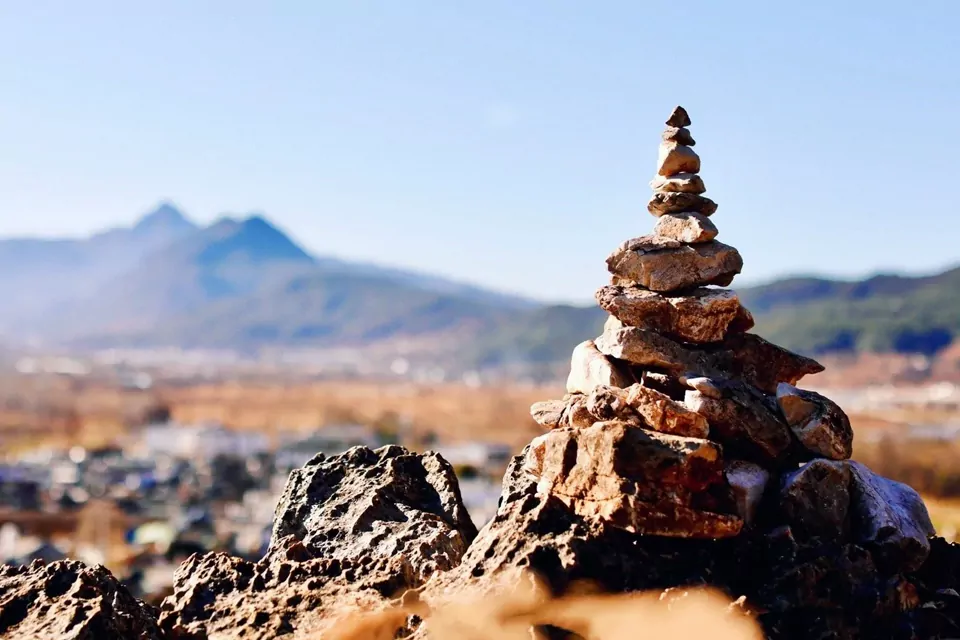
Etiquette: never remove stones, never rearrange a wall for a better photo, never climb onto mani walls, and never carve on a protected or ancient stone. Always walk to the left of a mani wall (clockwise past it) rather than cutting along its face.
Why it stays with you: this is the only souvenir in Tibet that stays exactly where you left it, in public, for years. It is also the only one that keeps working - the mantra on it is still being read by every pilgrim who passes.
A khata is a white silk or linen scarf, the Tibetan gesture for respect, blessing, congratulations and farewell. You will be given one at the airport, at a monastery, at a family home. You can also offer one yourself.
How to do it: buy a khata at any shop around the Barkhor. Offer it with both hands and a slight bow to a monk, to the statue of the Jowo Shakyamuni in the Jokhang (place it on the railing or where indicated, not on the statue itself unless permitted), or hang it at a mountain pass beside the prayer flags. You can also give one to your guide or driver at the end of the trip - it is the simplest and most correct way to say thank you in Tibet.
Etiquette: accept a khata with both hands or with your head slightly bowed as it is placed around your neck; do not immediately stuff it into your bag in front of the person who gave it.
The Barkhor is the pilgrim circuit around the Jokhang - roughly 30 to 40 minutes at an unhurried pace, always clockwise. Larger circuits, the lingkhor, ring the old city. In Shigatse, pilgrims circle Tashilhunpo monastery. This is not a sightseeing route; it is a moving prayer.
How to do it: join the flow, walk clockwise, spin the rows of hand-prayer-wheels with your right hand as you pass so they continue turning, and let pilgrims overtake you. Early morning and late afternoon are the best times - you will be walking with local people rather than tour groups.
Etiquette: never walk counter-clockwise around a monastery, stupa or mani wall. Do not stop in the middle of the flow to pose for photos. Keep your voice low.
Sang is a smoke offering: juniper branches and aromatic plants, mixed with tsampa (roasted barley flour) and a little butter, burned at passes and sacred sites. When Tibetans cross a high pass they stop, add to the fire, and shout "Lha gyalo!" - "victory to the gods".
How to do it: at larger passes such as Kamba La above Yamdrok Lake, or the Khampa La viewpoint on the Everest road, you will find sang burners and vendors selling bundles of juniper. Buy a small bundle, add it to the fire, sprinkle a pinch of tsampa, and call out with the crowd. Your guide will show you the sequence.
Etiquette: keep the fire small and controlled, never leave a fire burning unattended in dry grassland, do not throw plastic or packaging into the burner, and do not photograph people mid-prayer from a metre away.
A lama can tie a short blessed thread around your wrist - sometimes red, sometimes yellow, sometimes braided with a protective knot. It is given as a blessing and worn until it naturally falls off. In many monasteries, asking politely (through your guide, with a small donation) is entirely normal.
Etiquette: do not cut it off because it looks worn, do not treat it as jewellery to be swapped for a bracelet, and do not ask for one during a ceremony in progress.
At the Jokhang, pilgrims offer gold leaf to the Jowo Shakyamuni statue, the most revered image in Tibet. The offering is arranged through the monastery, usually with a modest donation; your guide can enquire whether it is possible on the day you visit.
Etiquette: follow the monastery's instructions exactly, do not touch the statue, do not attempt photography of the offering process, and accept a "no" without pressing. Even when the offering is not possible on your date, watching pilgrims do it is worth an unhurried half hour.
This is the most underrated "personal ritual" in Tibet and costs nothing. In a tea house or a monastery guest room, you will be served butter tea - salty, rich, faintly cheesy - and a bowl of tsampa. The traditional way: take a handful of tsampa, add butter tea, and roll it in your palm into a small ball.
Etiquette: accept the first cup and take at least a sip; refusing food outright is impolite. Hold the cup with both hands when it is offered. Do not tip the tsampa onto the floor, and do not comment loudly on how strange the butter tea tastes - most people end up missing it within a week.
If the ten above are the headline rituals, these are the quieter ones - easier to arrange, less crowded, and just as personal.
Foreign visitors cannot travel in Tibet independently. You need a Tibet Travel Permit, arranged by a licensed agency and typically issued in about 2 to 3 weeks - apply earlier in peak season. You must already hold a valid Chinese visa in most cases (the permit is shown alongside it when boarding your flight or train to Lhasa). Travel to Shigatse, Everest Base Camp, Mount Kailash or the far west requires additional Aliens' Travel Permit documents, and some areas require a further military permit. Travellers entering overland from Nepal receive a Chinese group visa arranged in Kathmandu - a route your agency must coordinate.
Lhasa: 3,650 m. Shigatse: 3,840 m. Yamdrok Lake: 4,400 m. Namtso: 4,718 m. Everest Base Camp: around 5,200 m. Build in two nights in Lhasa before any high pass, drink more water than feels reasonable, skip alcohol for the first days, eat lightly, and walk slowly even when you feel fine. If you have heart, lung or severe blood-pressure conditions, consult your doctor before booking. Discuss acetazolamide (Diamox) with a physician rather than self-medicating on arrival.
Walk clockwise around monasteries, stupas and mani walls. Remove hats inside chapels. Do not touch statues, thankas or the flame of lamps. Ask before photographing monks or pilgrims, and never photograph during a ceremony. Do not smoke or spit in monastery courtyards. Avoid shorts and sleeveless tops at religious sites. Do not hand money directly to a child - give through a parent or not at all.
Seven to eight days covers Lhasa and the classic central Tibet loop. Ten to twelve days adds Everest or Namtso. Fourteen days and up opens the far west toward Mount Kailash. Most meaningful personal rituals - the lamp, the flags, the beads, the stones - need only a few unhurried hours in Lhasa, which is why even a short itinerary can feel complete.
Lhasa (3 nights: Potala, Jokhang and Barkhor kora, Sera and Drepung) → Yamdrok Lake and the Kamba La pass (prayer flags, sang offering) → Shigatse (Tashilhunpo, mani walls, local workshop) → Everest Base Camp and Rongbuk → return to Lhasa. Add Namtso if you have two more days and want the highest lake of the journey.
Q1: Can I really light a butter lamp or hang prayer flags as an ordinary tourist, or is that only for pilgrims?
Both are normal and welcome for respectful visitors. Lighting a lamp at the Jokhang is a simple purchase, and prayer flags can be hung at passes and lakeside sites with your guide's guidance. The rule is the same in both cases: do it quietly, do it properly, and don't treat it as a photo opportunity.
Q2: What should I do with my prayer beads, mani stone or khata after the trip?
Keep the beads - that is the point. A mani stone stays where you placed it, on the wall; that is also the point. A khata can be kept at home on a shelf, tied to a window, or left at a pass on a later trip. Nothing needs to be discarded, and nothing should be thrown away casually.
Q3: Is it acceptable to buy these items? Doesn't that commercialise the ritual?
Buying a lamp, a string of flags, a stone or a set of beads is how local pilgrims themselves participate, and the small trade supports families around the Barkhor and monastery entrances. What matters is the intent: an offering is an offering whether the object cost two yuan or two hundred.
Q4: How much of this can I fit into a short trip?
More than you expect. Lhasa alone gives you the Jokhang lamp, the Barkhor kora, prayer beads, a khata offering and a mani stone in two unhurried days. Flags and the sang offering fit naturally into the Yamdrok Lake day. A seven- or eight-day itinerary can comfortably include five or six of the ten rituals above.
Q5: Is Tibet suitable for student groups and educational travel, not just independent travellers?
Yes, with planning. School and university groups travel in Tibet frequently, and the ritual-based experiences here are unusually good educational material - they turn abstract lessons about culture and belief into something students do with their hands. Group permits, guides, altitude pacing and age-appropriate schedules all need to be arranged in advance, which is exactly what a specialist operator handles.
Tibet does not reward passive travel. The plateau is too high, the light too strong, the distances too long for you to spend the whole trip behind a lens. Sooner or later you will be standing in a courtyard with a lamp in your hands, or on a pass with a bundle of juniper, or at a mani wall with a stone you chose yourself, and you will realise you are not visiting a place - you are leaving something in it.
Take the lamp. Hang the flags. Stack the stone. Carry the beads home. And when you are ready to plan the route that makes all of it possible, explore our Tibet tours for itineraries covering Lhasa, Yamdrok Lake, Shigatse, Everest Base Camp and Namtso - with all permits, guides and group logistics arranged in advance.
