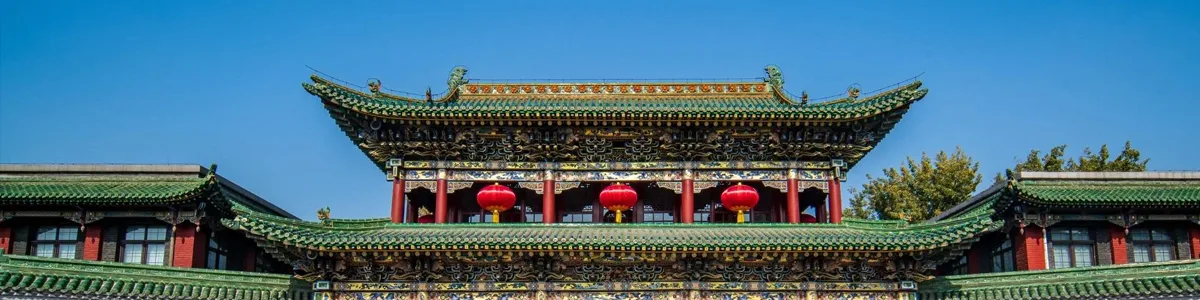
Destinations: Jin Merchant Culture Tour
Between the eighteenth century and the 1920s, a handful of families from the Taiyuan basin ran the most sophisticated financial network in Asia. Their men walked out through the pass at Shahukou into Inner Mongolia with brick-tea on their backs; their draft banks in Pingyao moved silver for merchants, officials and the imperial treasury without ever moving the silver itself; their compounds, forty minutes apart in the same valley, still stand with their carved gates, their private theatres and their written rules about honesty.
This seven-day route follows that arc. You begin in Taiyuan with the provincial museum's merchant archive, move to Pingyao where the first Chinese draft bank opened in 1823, walk the courtyard houses of the Qiao, Wang and Chang families, stand at the walled pass where migration and trade left Shanxi, and finish among the Song dynasty halls and vinegar yards of Taiyuan. Distances are short, accommodation is inside the old town, and every site is introduced by someone who lives in the region.
HIGHLIGHTS
DAY 1 - TAIYUAN: THE ARCHIVE BEFORE THE HOUSES
Arrive at Taiyuan Wusu airport or the high-speed rail station and transfer to the city centre. A short orientation walk introduces the Taiyuan basin, the four merchant counties and the geography that made trade westward the only option.
Shanxi Museum, and specifically its Ming and Qing merchant exhibition: partnership contracts, staff rule books, remittance slips, travel permits. This is the evidence you will recognise on the ground for the rest of the week.
Dinner of Shanxi staples - hand-cut noodles, aged vinegar, braised pork with steamed bread - and an opening talk on who the Jin merchants were, how they financed themselves, and why their story ended. Learning objective: Be able to name the three businesses that made Shanxi rich - salt and iron, the tea road, and the draft banks - and place each on a map.
DAY 2 - PINGYAO: WHERE THE FIRST BANK OPENED
Drive to Pingyao (about ninety minutes) and enter through the north gate. Walk the Ming wall, then the old town's financial street: Rishengchang, founded in 1823 by a dye-shop owner named Lei Lüthai, and Xie Tong Qing next door, whose underground vaults held silver for the whole network. The escort agency museum, where armed guards were hired to move specie, and the Qing government's own banking office. Then the market street, with its pawnshops and grain brokers.
The walking theatre production "See Pingyao Again", staged inside a purpose-built venue in the old town. Dinner afterwards at leisure. Learning objective: Explain how a remittance system replaced the physical transport of silver, and identify the two risks it had to solve - forgery and trust.
DAY 3 - SCULPTURE, THEN THE LARGEST HOUSE
Twenty minutes outside the walls to Shuanglin Temple, whose painted clay figures fill ten halls, and Zhenguo Temple, with a tenth-century hall that survived every war since.
Drive to Lingshi (about forty-five minutes) for the Wang Family Compound: five lanes, five castle-like courtyards, and a clan that produced officials as well as merchants. Walk the carved stone balustrades and the raised lane that connects the courtyards.
Return to Pingyao. Free time; optional noodle-making session in a family kitchen. Learning objective: Compare religious patronage with domestic display - who paid for both, and what each was meant to prove.
DAY 4 - TWO COURTYARDS AND A FILM SET
Drive to Qi county for the Qiao Family Compound, a compact network of six courtyards and nineteen gates that Zhang Yimou used for Raise the Red Lantern. Read the couplets over the doors: they are the family's public moral programme.
On to Yu Ci for the Chang Family Compound, the largest of the merchant estates, with gardens, a library and a private theatre. Then return to Pingyao or continue to Taiyuan depending on the hotel plan.
Dinner in the old town, and a short session on the "human share" (shenggu) system, by which senior employees were paid in profit shares rather than wages. Learning objective: Understand two ways a family firm bought legitimacy: public virtue in stone, and private scholarship behind the gate.
DAY 5 - SHAHUKOU: THE PASS AND THE MIGRATION
Early departure for Youyu county and the Shahukou pass (about two and a half hours), the fortified gateway on the Great Wall line through which Shanxi men left for Inner Mongolia. Walk the reconstructed wall and the old commercial street.
The migration museum, and a talk with a local historian about the seasonal labour, the caravan trade and the family remittances that came back to Shanxi. Return towards Taiyuan in the late afternoon.
Dinner en route or in Taiyuan. Evening at leisure. Learning objective: Connect a landscape feature - a pass - to an economic system, and explain why "going beyond the western pass" was a rational choice rather than an exile.
DAY 6 - TAIYUAN: TEMPLE, VINEGAR AND THE BALANCE SHEET
Jinci Temple on the edge of the city: the Song dynasty Sacred Mother Hall, the cross-shaped bridge over the fish pond, and the spring that made the site sacred for two thousand years.
A working vinegar yard, where sorghum is steamed, fermented and aged in ceramic jars for years. Then free time for the old city or the museum's merchant archive if you want a second look.
Farewell dinner with a Shanxi noodle chef at the table, and a closing discussion on why the draft banks collapsed after 1911. Learning objective: Explain the decline in three causes - modern banks, rail and telegraph, and the political unsettlement of the republic - and judge which one was decisive.
DAY 7 - DEPARTURE
Free morning, transfer to Taiyuan Wusu airport or the high-speed rail station for Beijing (about three hours), Xi'an (about three hours) or Datong.
Departures. Guests extending to Datong or Mount Wutai leave after breakfast. No evening activity. Learning objective: Leave with a mental map of Shanxi's merchant geography and a working understanding of how Chinese credit worked before banks.
OPTIONAL EXTENSIONS