"Cultural immersion" is one of the most overused phrases in international education. In practice, most programmes offering it deliver a sightseeing itinerary with a calligraphy session attached. Students visit heritage sites, take photographs, attend one craft workshop and return home with the impression that Chinese culture is a series of beautiful objects. That is appreciation, not immersion, and the difference matters to any school that expects measurable learning.
Genuine cultural immersion is structural. It requires that students spend sustained time inside the ordinary life of a place, that they encounter cultural content in its original context rather than in a demonstration setting, that they must interact rather than observe, and that they are given time to be confused, corrected and eventually competent. This article sets out how such a programme is designed and what it produces.
Tourism moves a person across a landscape. Immersion moves a person into a social position. The practical markers are straightforward.
In a tourism model, the student is a spectator: a guide explains, the group listens, photographs are taken, the bus departs. In an immersion model, the student is a participant with obligations: a task to complete, a partner to talk to, a daily routine to manage, a small budget to spend, a question to answer in front of others.
In a tourism model, cultural content is presented in a curated display — a folk performance, a demonstration workshop, a reconstructed street. In an immersion model, the same content is encountered where it is actually practised: a working tea terraces, a neighbourhood market at seven in the morning, a family kitchen, a school classroom, a municipal park where retirement-age residents do tai chi at dawn.
Both models can be well executed. But only the second produces the specific outcome schools want: cultural competence rather than cultural consumption.
Layer one - language in use. Even students with minimal Mandarin gain enormously from structured use of it. The most effective format is not classroom instruction but daily micro-tasks: buy a metro ticket, order breakfast, ask directions, negotiate a small purchase, greet a host family, take a photograph with permission. Each task produces a short spoken exchange and a visible success or failure. Students remember these far longer than vocabulary drills.
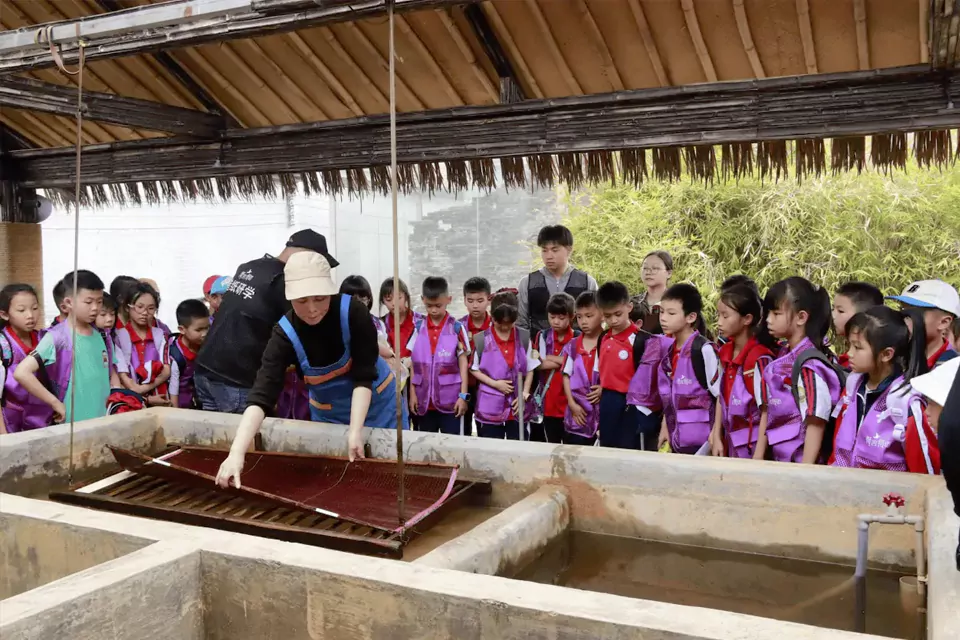
Layer two - craft and skill transmission. Real cultural learning happens through the hands. Tea processing, silk or indigo dyeing, porcelain painting, paper cutting, dumpling and noodle making, bamboo weaving, opera mask painting, shadow puppet construction. The value is not the souvenir; it is the discovery that these skills are difficult, that they take years, and that the person teaching them has devoted their life to a specific competence. Students who experience that once tend to look differently at every museum object afterwards.
Layer three - heritage in context. Heritage sites should be sequenced rather than collected. A programme that visits temples, palaces and museums in random order produces visual fatigue. A programme that first teaches the underlying logic — dynastic cycle, ritual order, vernacular housing, water management, trade routes - and then visits two or three sites that demonstrate it produces understanding.
Where possible, arrange access outside peak hours, and pair every major site with a smaller, quieter site that illustrates the same theme without the crowd.
Layer four - food as a cultural system. Cuisine is the most accessible entry point into a culture and the most frequently wasted. A proper food component includes: a region-specific meal with explanation of why these flavours belong here; a market visit early in the morning with a chef or food historian; a hands-on cooking session of two or three dishes; and student-led ordering practice with a small budget at least once.
Dietary requirements must be handled seriously — including vegetarian, halal, gluten-free, nut allergies and religious fasting — and communicated to every kitchen in advance rather than improvised at the table.
Layer five — ordinary life and local peers. The most memorable element of any immersion camp, according to students themselves, is usually not a heritage site. It is time spent with people of their own age. A buddy pairing sustained across several days, a shared class, a joint sports session, a group project, an evening of games without a formal programme.
This layer cannot be faked with a single welcome ceremony. It requires repeat contact and a task that forces cooperation.
Immersion is physically and cognitively demanding. A schedule that runs from eight in the morning to nine at night produces students who retain nothing and complain about everything.
A workable daily rhythm for a two-week immersion camp:
Early morning - an active, outdoor or market-based activity while it is cool and the city is itself.
Late morning - the main learning block: a workshop, a site visit with structured tasks, or a language-in-use session.
Early afternoon - rest, or a low-intensity cultural activity such as a museum with a specific focused question.
Late afternoon - peer interaction, sport, free exploration in a supervised zone, or project work.
Evening - either a cultural performance, a group meal, or free time with defined boundaries.
One day in five should be genuinely light. Students need a pause to consolidate.
Schools increasingly need evidence. Immersion programmes can generate it without becoming academic courses. Practical instruments:
A daily short reflection entry in a physical journal - one observation, one surprise, one question.
A pre- and post-programme self-assessment on cultural confidence, language willingness and comfort with difference.
A final group project - a short film, a photo essay, a map, an exhibition - that synthesises what the group encountered.
A teacher-observed rubric on participation, curiosity, cooperation and resilience.
These are simple and credible. They convert a travel experience into an educational record.
The strongest immersion programmes concentrate. Two or three cities, with one of them smaller and less international.
Beijing for the national narrative, imperial scale and the depth of institutional culture.
Xi'an for ancient civilisation, Silk Road exchange and a visible craft heritage that still operates commercially.
Hangzhou for aesthetics, tea culture, water towns nearby, and the quietest register of the major destinations.
Chengdu for food culture, teahouse life and a genuinely different tempo from the coastal cities.
Quanzhou, Kaifeng or Jingdezhen for specialist programmes - maritime Silk Road, Song dynasty urbanism, or porcelain, respectively. These are less convenient and more rewarding.
A common mistake is adding a fourth city to a two-week programme. The fourth city usually costs a full day of transfer and removes a day of immersion.
Is a language prerequisite required? No. Programmes are delivered in English with structured Mandarin practice. Students with existing Mandarin are given more demanding tasks.
How much free time do students get? Supervised independence is built in deliberately — typically a two-hour block on several afternoons, in a defined area, with check-in points.
Can dietary restrictions be accommodated? Yes, provided they are declared at the planning stage. Halal, vegetarian, gluten-free and allergy protocols are arranged in advance.
Is this suitable for students who have travelled little? It is often most valuable for them. The programme is structured and supervised, and independence is introduced gradually.
Cultural immersion is not a longer version of cultural tourism. It is a different structure: participation instead of observation, hands instead of photographs, peers instead of audiences, and time instead of coverage. Designed properly, a two-week camp produces students who can talk about China from inside their own experience rather than from a guidebook.
PandaStudyTour builds immersion camps across all major destinations with each of these layers written into the itinerary. Explore further programme designs in the China Summer Camp Insights hub, or ask us to build a custom immersion schedule for your cohort.
