There is a moment in every summer camp operator's life when a parent asks whether the programme is "suitable for a fifteen-year-old." The honest answer is that a programme built for ten-year-olds is not, and simply putting teenagers in the same building does not make it so.
Adolescents are not large children. Their learning needs, social needs, risk profile and reasons for being there are all different. A teenager who is treated as a child disengages; a teenager who is given genuine responsibility rises to it. The same four weeks can produce a confident intermediate speaker or a resentful phone-addicted guest depending on how the programme is designed.
This article is about how a Chinese summer camp for teenagers should be built, and what parents should look for when evaluating one.
Cognitive capacity is not the constraint. Teenagers can handle abstract grammar, faster pacing and more demanding content than younger learners. A programme that keeps them on songs and flashcards is insulting them.
Motivation is the constraint. Adolescents learn languages for reasons that are socially mediated: wanting to be competent, wanting to be interesting, wanting to prove something to themselves or to a parent. A camp that gives them visible progress and a degree of autonomy meets that; a camp that treats them as passive recipients does not.
Social risk is the constraint. This is the age at which being wrong in front of peers feels genuinely dangerous. A classroom that forces public error without a safe structure produces silence. This is why adolescent language teaching requires careful pair and small-group work rather than whole-class performance.
Identity work is happening. A four-week overseas stay during adolescence is often a formative experience independent of the language outcome. That is an argument for taking pastoral design seriously rather than treating it as a nice-to-have.
Risk profile is different. Older teenagers want freedom: to go out, to choose their own activities, to manage their own time. A programme that offers zero freedom loses them; a programme that offers unstructured freedom creates liability. The answer is structured autonomy: real choices inside defined boundaries.
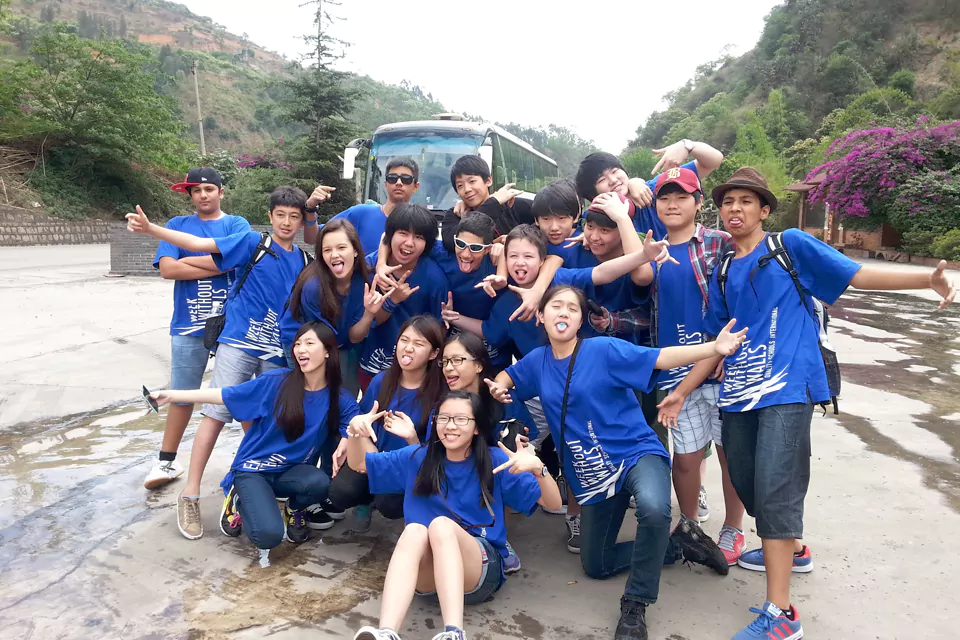
Age determines pastoral grouping; level determines academic grouping. A fifteen-year-old beginner should not be in a class with thirteen-year-old near-fluent heritage speakers, and vice versa. Camps that group purely by age produce classes that satisfy nobody.
The practical approach: academic classes by tested level; social and evening groupings by age band. These two structures run in parallel and do not need to match.
Above eight students per class, individual speaking time in a ninety-minute block falls below the threshold where improvement happens. Six to eight is the working range. Ask for the maximum and ask whether it is enforced.
Teenagers respond to: music, sport, food, technology, film, social issues, careers, travel, identity. They do not respond well to: a textbook unit about buying stamps. A well-designed curriculum uses teenage-appropriate themes to carry the same core structures — comparison, opinion, past narration, future plans, persuasion.
The morning class should exist to enable the afternoon. A group that has spent the morning learning comparative structures should spend the afternoon interviewing three people at a market about which of two products is better and why, then reporting back. That is a real task with a real audience.
Give a genuine choice menu: a sports track, an arts track, a food track, a photography track. Let students choose for the second half of the programme. Autonomy inside boundaries produces engagement; autonomy without boundaries produces management problems.
This is the point most programmes quietly fail. If all campers share English, English becomes the working language of friendship and Mandarin becomes homework. Camps that work create structures where Mandarin is genuinely needed: Chinese buddies attached to small groups, joint projects with local students, group tasks where the only interpreter is a Chinese peer.
Teenagers require a different safeguarding posture from children: less hand-holding, more boundary management.
Ratios. A ratio appropriate for a thirteen-year-old is tighter than for a seventeen-year-old. Ask for the specific ratio and how it changes across the age band, not a single number for the whole camp.
Night supervision. Who is on duty, where, and how quickly can they be reached. Ask for the arrangement in writing.
Movement and sign-out policy. When can students leave campus, with whom, and what record exists? "They're old enough to be sensible" is not a policy.
Incident reporting. What happens when something goes wrong, who is informed, and how quickly are parents contacted? A programme with a documented protocol answers this in one sentence.
Medical capability. Nearest clinic, named contact, insurance requirement, medication handling. Particularly relevant for students with allergies or ongoing conditions.
Digital policy. This deserves its own section below, because it is the single most contentious rule in any teenage programme.
Staff vetting and code of conduct. Background checks, reference checks, and a written behavioural code with a named safeguarding lead.
A programme should be able to answer all seven without hesitation. Hesitation on any one of them is data.
Every camp now faces the same question: how much device access should teenagers have?
The arguments are real on both sides. Parents want reachability. Students want autonomy and social connection. Programmes want immersion.
What actually works in practice is a middle architecture rather than an outright ban or an open policy:
The camp that confiscates phones entirely tends to produce smuggling and friction. The camp that permits unlimited use produces students who learned less than their parents paid for. The workable version is structured and explained.
The failures that damage a teenage programme are rarely dramatic. They are social.
Homesickness at week two. It typically peaks around day eight to eleven, not on day two. Programmes that front-load excitement and provide nothing at the midpoint see a dip. Good programmes build a mid-programme anchor: a bigger activity, a rest day, a communication window.
The dominant subgroup. Three or four students with strong personalities can set the tone for thirty. Staff who notice this early and gently redistribute groupings prevent months of brochure damage.
The isolated student. The one who does not click. This is where individual attention from a named staff member matters, and where roommate matching policy becomes a pastoral instrument rather than an administrative detail.
The over-scheduled collapse. Teenagers are resilient but not invincible. Twelve-hour days for three weeks produce illness, irritability and, occasionally, a genuine crisis.
The language plateau. Around the third week, students who have been coasting on the same dozen phrases stop progressing. Programme design should anticipate this with a level-appropriate push — a new task type, a new interlocutor, a presentation, an interview.
For a fourteen to seventeen-year-old with no prior Mandarin, four weeks typically produces:
For a student with two or three years of school Mandarin, the gains concentrate in fluency and confidence rather than new structures. They arrive able to conjugate and leave able to converse, which is a different skill.
What four weeks does not produce: fluency, an accent indistinguishable from a native speaker, or a jump of several HSK levels. Those claims belong in advertising, not in planning.
The most valuable outcome, and the one that rarely appears in a progress report, is that the student now has a relationship with the language rather than a subject called Mandarin.
Parents often ask why a sixteen-year-old would want this.
The answer, from students who return and want to go again, tends to be one of four things:
A camp that delivers only language, and no experience of independence or belonging, under-serves this age group badly.
What is the minimum age for a residential teenage programme?
Most residential programmes begin around eleven or twelve, with tighter supervision at the lower end. Thirteen to seventeen is the core band for the design described here.
Can a seventeen-year-old and a thirteen-year-old be in the same group?
For classes, level matters more than age. For social and evening activity, age bands should be separate. Ask specifically how the programme handles the split.
Is there any free time? There should be structured free time - defined windows, defined boundaries, defined options - rather than either a rigid schedule or unstructured freedom.
How much Chinese contact is there with local teenagers?
This varies enormously between programmes and is the right question to ask in detail. Look for scheduled, recurring joint activities rather than a one-off cultural exchange afternoon.
Will my teenager be supervised at night?
Yes, with a named duty arrangement. Ask for it in writing rather than accepting a verbal assurance.
What if they are vegetarian or have allergies?
Disclose at booking. Kitchens and homestay families can accommodate most requirements with notice, but not with a request made on arrival.
Do you offer shorter options for a first experience?
Yes. Two-week formats are common for a first residential trip and are a sensible way to test readiness before a longer programme. Details are on our Chinese Mandarin Summer Camp page.
A Chinese summer camp for teenagers succeeds when it treats adolescents as capable people who need boundaries rather than as children who need supervision, and when it builds a social world in which Mandarin is useful rather than merely taught.
Parents evaluating options should worry less about the campus photographs and more about ratios, class sizes, local peer contact, the mid-programme dip, and whether the phone policy is a rule or a reason.
If you are planning a teenage placement for next summer, our Chinese Mandarin Summer Camp page sets out the age bands, supervision model, sample timetable and the phone policy — and we will answer the safeguarding questions in writing before you decide anything.
