Educational travel to China has changed dramatically in the past decade. Ten years ago, most international schools that wanted to bring students to Asia chose short sightseeing trips built around a handful of landmarks. Today, teachers, principals, university faculty and student travel coordinators are asking for something very different. They want structured learning outcomes. They want real classrooms, real laboratories, real conversations with Chinese students of the same age. They want their students to come home with a genuine understanding of how the world's second-largest economy actually works, not just a set of photographs from the Great Wall.
This shift has created enormous demand for specialist operators who understand education rather than pure tourism. A conventional travel agency can book a hotel and a bus. It usually cannot explain why a particular university laboratory is worth visiting, how to arrange a faculty lecture at short notice, what a Chinese high school timetable really looks like, or how to build a curriculum-linked programme that satisfies a school board back home.
That is precisely the gap PandaStudyTour was created to fill. We are not a general travel company that added the word "study" to its brochure. We are a dedicated China study tour agency built from the ground up around the needs of schools, universities, youth organisations and corporate learning teams who want to travel to China with a clear educational purpose.
PandaStudyTour is a China-based educational travel agency specialising in inbound study tours, campus visits, cultural immersion programmes, summer camps and customised learning journeys for international groups. Our team combines three skill sets that rarely sit in the same room: academic programme design, on-the-ground operational logistics inside China, and bilingual coordination between international clients and Chinese institutions.
We work in English, Mandarin and several other languages, and we operate from inside China rather than from overseas. That matters more than it might sound. When a flight is delayed, when a partner university changes a laboratory access date, when a typhoon affects a coastal city itinerary, or when a student falls ill on day four, an operator who is physically on the ground in China with established institutional relationships can solve problems in hours. An overseas intermediary usually cannot.
Everything we deliver is group based. We do not sell individual tourist tickets. We build programmes for school delegations, university exchange cohorts, teacher professional development groups, high school STEM clubs, vocational training teams, corporate innovation study groups, family learning groups and youth summer camp cohorts. Teaching is our subject matter, and travel is our medium.
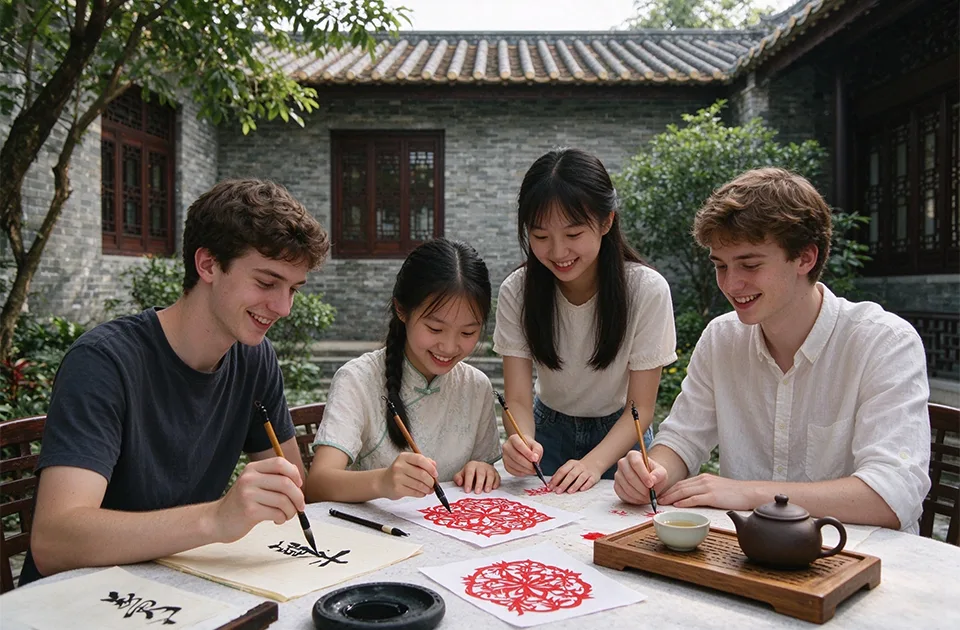
There are many companies that will happily sell a China itinerary. Here is what makes choosing us different.
1. Education-first programme design. Every itinerary starts with a learning objective, not a hotel list. Before we propose a single activity, we ask what your students should be able to explain, describe or do by the end of the trip. Only then do we select the universities, enterprises, cultural sites and workshops that will actually deliver that outcome. This is why our programmes read like curricula rather than travel brochures.
2. Real institutional access. Anyone can photograph a university gate from outside. We arrange official campus entry, laboratory visits, faculty lectures, student exchange sessions and classroom observations through formal institutional channels. These permissions are negotiated in advance and are subject to university approval, and we manage the whole application process on your behalf.
3. Genuine customisation, not a menu of fixed tours. Our programmes are assembled fresh for each client group. Duration can flex, theme can flex, academic depth can flex, activity mix can flex. A group of fourteen-year-old beginners and a group of postgraduate engineering students can visit the same city and receive completely different programmes, because the design is driven by the learner rather than the destination.
4. Bilingual coordination end to end. Language is the single most common failure point in educational travel to China. We provide bilingual guides, academic interpreters for technical sessions, translated briefing packs, pre-departure orientation materials and a single English-speaking coordinator who stays reachable throughout the programme.
5. Safety and duty of care as a default. Group leaders travelling with minors carry serious responsibility. We build programmes around risk management: verified accommodation, insured transport, trained on-tour staff, health and safety briefings, meal planning that respects dietary and religious requirements, and clear escalation procedures documented before departure.
6. Transparent pricing. Institutional budgets are scrutinised. We quote in a way that separates programme fees, accommodation, transport and optional additions, so that procurement teams can review and compare line by line.
PandaStudyTour operates several distinct but connected service lines. Most clients begin in one and later expand into others once they see how the model works.
Our flagship service is the design and delivery of structured educational tours across China. These programmes typically run from five to fourteen days and combine university visits, enterprise visits, cultural immersion, workshops and structured reflection sessions. They are built for high schools, universities, colleges, youth organisations and professional delegations.
Our full range of China study tours covers destinations including Beijing, Shanghai, Xi'an, Chengdu, Guangzhou, Shenzhen, Hangzhou, Suzhou, Guilin, Yunnan, Harbin and many smaller regional centres, each with a distinct academic and cultural profile. A group studying ancient civilisations and a group studying artificial intelligence will not receive the same itinerary, even if they land in the same airport.
Short-format immersive programmes are one of the fastest-growing segments of educational travel to China. Our Chinese summer camp programmes are designed for younger learners, typically primary through senior high age, and balance Mandarin language learning, cultural workshops, peer exchange with local students and supervised recreational activity. Camps can be themed around language immersion, STEM and innovation, traditional culture, ecology and sustainability, or sport and outdoor education. Because Southeast Asian families in particular face short flight times and low travel friction, our Guangzhou and Shenzhen camp routes have become especially popular with groups from Singapore, Malaysia, Thailand and Vietnam.
For groups whose objectives sit closer to cultural and general educational travel than to formal academic exchange, we also design structured China tour packages that package transport, accommodation, guiding, meals and activities into a coherent, manageable programme. These suit first-time visiting delegations, family learning groups, teacher cultural groups and organisations that need a reliable operational backbone without a heavy academic component.
One of our most requested specialist services is the arrangement of official university campus visits. We work with a wide network of Chinese institutions, from flagship Double First-Class universities to Sino-foreign cooperative universities and leading vocational universities, arranging guided campus tours, laboratory access, faculty lectures, student panel discussions and research exchange sessions. Groups from overseas universities frequently use these visits to explore future exchange partnerships, articulation pathways and joint research possibilities.
A growing portion of our work is corporate. Companies and industry associations send teams to China to study manufacturing practice, supply chain models, technology commercialisation, urban development or education-industry links. We design business-focused programmes combining factory and enterprise visits, university technology-transfer briefings, sector lectures and structured debriefs.
Principals, curriculum leaders and teacher trainers increasingly travel to China to observe pedagogy, discuss curriculum design, examine digital education practice and compare school systems. We build focused professional development programmes combining school visits, classroom observation, faculty seminars and reflective workshops.
China is not one market, and effective study tours reflect regional difference. Our network spans the country.
Beijing remains the essential destination for political, historical and institutional learning: national museums, heritage sites, top research universities and policy-oriented institutions.
Shanghai offers finance, trade, urban planning, design and international business, alongside a dense cluster of leading universities and a strong international school ecosystem.
Xi'an is unmatched for ancient civilisations, Silk Road history, archaeology and heritage conservation, and pairs naturally with courses on Chinese history and cultural heritage management.
Guangzhou and Shenzhen together form the engine room of the Greater Bay Area. Guangzhou brings centuries of trading heritage, Cantonese culture, medicine and agriculture; Shenzhen brings frontier technology, start-up ecosystems, smart manufacturing and China's most innovation-focused universities.
Chengdu offers a gentler pace, exceptional food culture, panda conservation research and strong links to ecology and rural development studies.
Hangzhou and Suzhou deliver classical Chinese aesthetics, garden design, tea culture and craft traditions alongside fast-growing technology and digital industries.
Guilin, Yunnan, Guizhou and Zhangjiajie provide field-study environments for geography, ecology, ethnic minority studies, rural development and environmental science.
Harbin and northeast China open up winter ecology, heavy industry, Russian-influenced architectural heritage and cold-climate engineering.
Hong Kong, Macau and Greater Bay Area combinations allow groups to compare systems directly, which is valuable for students of law, finance, education policy and urban governance.
A single programme can connect several of these regions, and we routinely build multi-city routes where the sequence itself teaches something, for example moving from historic inland China to the coastal innovation belt.
Transparency about process builds trust, so here is how a typical programme comes together.
Step 1: Discovery conversation. We clarify group size, age range, subject focus, dates, budget band, dietary and religious requirements, accessibility needs, supervision ratios and any institutional constraints or approval requirements.
Step 2: Learning objective mapping. We convert the group's goals into a written set of intended outcomes. This document becomes the standard against which every proposed activity is judged.
Step 3: Draft itinerary design. We propose a day-by-day structure with themes, activity types, academic components and pacing. Nothing is fixed at this stage; the draft exists to be argued with.
Step 4: Institutional applications. We approach universities, schools, enterprises and research institutes to secure access permissions, guest speakers and exchange sessions. Lead times here are the single biggest determinant of what is possible, which is why we ask clients to plan well ahead.
Step 5: Logistics confirmation. Accommodation, transport, meals, insurance, staffing, safety documentation and contingency planning are locked in and documented.
Step 6: Pre-departure preparation. Group leaders and students receive orientation materials covering cultural norms, language basics, health and safety, programme expectations and what to pack.
Step 7: On-tour delivery and adjustment. Our coordinators manage the programme live, handle changes and remain accountable throughout. Nothing is left to chance and no problem is left to the client to solve alone.
Step 8: Post-programme review. We gather structured feedback from group leaders and, where appropriate, issue participation certificates and programme summary documentation useful for school records and student portfolios.
The questions group leaders ask most often are practical ones, and they deserve honest answers.
Visas and entry. Entry requirements for China vary by nationality and change over time. Many countries now benefit from visa-free arrangements or simplified application processes, while others still require formal visas. We provide current guidance and supporting documentation, but final visa decisions rest with Chinese authorities and we always advise clients to verify with their nearest Chinese embassy or consulate.
Accommodation. We select properties based on location, safety record, group capacity and suitability for minors. Central locations reduce transport risk and travel fatigue.
Transport. All group transport is arranged with licensed operators and insured vehicles, with drivers experienced in student group travel.
Staffing. Programmes include bilingual guides and, where appropriate, dedicated coordinators. Supervision ratios are agreed with the client in advance and follow the client institution's own duty-of-care policy.
Health and dietary needs. We plan meals around allergies, vegetarian and vegan requirements, halal requirements for Muslim groups, and other religious or medical dietary needs. Medical facilities near each stop are identified in advance and included in safety documentation.
Emergency procedures. Every programme carries a written contingency plan covering illness, injury, lost participants, weather disruption, transport failure and communication protocols between on-tour staff, group leaders and families.
Our client profile is broad but coherent. Every group shares one characteristic: they are travelling to learn, not merely to see.
Secondary schools and international schools bringing subject-linked cohorts for history, geography, business, science, language or cultural programmes. These groups need careful pacing, strong supervision and activities that connect back to classroom content.
Universities and colleges running short-term faculty-led programmes, exchange preparation visits, field schools, summer schools or discipline-specific study trips. Engineering, business, medicine, education and social science faculties are our most frequent academic partners.
Vocational and technical institutions studying applied training models, industry-education integration and skills frameworks.
Youth organisations and summer camp providers needing safe, well-structured short programmes for younger participants.
Corporate and government delegations examining innovation ecosystems, manufacturing capability, education policy or urban development.
Family and multi-generational learning groups seeking a structured but flexible cultural programme with genuine depth.
Educational travel succeeds when participants can articulate what changed in their thinking. In practice, groups consistently report four kinds of gain.
First, comparative perspective. Students who have sat in a Chinese classroom, spoken with Chinese peers and seen a Chinese laboratory understand their own education system differently. Comparison is a powerful teacher.
Second, language confidence. Even short immersion produces a measurable shift, particularly for younger learners who lose their fear of speaking.
Third, career clarity. University and enterprise visits give students concrete information about study pathways and industry realities that no brochure can provide.
Fourth, genuine intercultural competence. Not the abstract version taught in a classroom, but the lived version that comes from navigating a different country with curiosity rather than anxiety.
Institutional access is the binding constraint in China study tour planning. University laboratories, faculty lectures and school classroom visits all require formal approval, and the strongest institutions have limited slots. Our general guidance is to begin planning twenty-five to thirty-five days ahead for standard programmes, and forty-five days or more where specialist laboratory, medical, clinical or research access is required. Peak periods, particularly summer months and Chinese public holiday windows, need earlier booking.
Group size also affects what is possible. Most institutional visits operate with minimum group sizes and sometimes maximum capacities. We recommend discussing numbers as early as possible so that access applications are realistic.
Finally, flexibility is a strategic asset rather than a weakness. The groups that enjoy the best programmes are usually the ones that define clear learning objectives but stay open about how those objectives are achieved. There is almost always more than one excellent way to teach a subject in China.
If you are a teacher, principal, faculty member, study abroad coordinator, training manager or group organiser considering a China study tour, the most useful next step is a short conversation about what your group needs to learn. From there, everything else follows.
PandaStudyTour designs, coordinates and delivers educational travel in China for groups who take learning seriously. We handle institutional access, academic content, logistics, language, safety and documentation, so that group leaders can focus on their students rather than on administration.
Whether you are planning a multi-city academic expedition, a language-focused Chinese summer camp, a first-time cultural learning tour, a university partnership visit or a corporate innovation delegation, we would be glad to build a programme around your objectives.
China study tours, campus visits, summer camps and customised learning journeys for international groups - designed by educators, delivered on the ground in China.
Contact PandaStudyTour to discuss dates, destinations and learning goals for your group, and we will return a draft programme built specifically for you.
