Planning an educational study tour from Malaysia to China comes with unique considerations that differ from groups based in Europe, Australia or Southeast Asian countries without deep Chinese cultural and Muslim community ties. Malaysian teachers, tour coordinators and parent committees often weigh overlapping priorities: meaningful curriculum alignment, suitable halal food and prayer facilities, language accessibility, reasonable flight times, safe logistics, and activities that feel engaging rather than scripted. Many organisers waste weeks comparing itineraries because generic China tour packages are built for general tourists, not for Malaysian school groups with mixed cohorts of Chinese-medium students, national-stream students, Muslim students and multi-ethnic learners. This guide is written specifically for you, to clarify which regions, themes and activities consistently work well for Malaysian school delegations, and which trade-offs you need to evaluate before locking in your tour.
First, it helps to start with the core traits that shape nearly every Malaysian school study tour. A large share of Malaysian independent Chinese secondary schools, SJKC and SMJK groups have students with varying Mandarin levels: some can hold fluent conversations, while others can only recognise basic characters. National school groups often have very limited Mandarin and require English-speaking facilitators throughout the programme. Halal catering and quiet prayer spaces are non-negotiable requirements for many groups, not optional extras. Flight routes are also a major deciding factor: Kuala Lumpur offers direct flights to multiple gateway cities in China, with most journeys between four and six hours. This keeps jet lag minimal compared with long-haul travel to Europe or the United States. Finally, Malaysian school holiday windows are fixed and relatively short. This means organisers cannot easily extend trips to compensate for poorly planned routing, and must prioritise compact, well-connected multi-city routes instead of scattered remote destinations.
South China, especially Guangzhou, Shenzhen and Zhuhai, remains the most popular first-time choice for Malaysian school delegations.
The direct flight from Kuala Lumpur to Guangzhou is frequent and affordable. For Malaysian Chinese student groups, this region carries gentle cultural familiarity without the overwhelming scale of northern China. Schools often pick Guangdong for two main purposes: heritage root-seeking and modern technology immersion. Visits to high-tech factories, innovation parks and universities in Shenzhen appeal to STEM, computer science and business students. At the same time, Cantonese cultural experiences, ancestral hall visits and village heritage walks resonate powerfully with Malaysian students whose families trace ancestral origins to Guangdong. Halal restaurants and prayer rooms are widely available in major commercial districts, universities and tourist precincts, which simplifies planning for multi-religion cohorts. The main downside for organisers to note is that summer months in Guangdong are hot and humid, so outdoor heritage walks need to be scheduled early in the morning.
Fujian, including Xiamen and Quanzhou, is the top destination for root-searching programmes for Malaysian Chinese schools.
Hokkien-speaking communities across Peninsular Malaysia share strong ancestral links with southern Fujian, which creates an immediate emotional connection for many students. Quanzhou, a UNESCO maritime trade city, is perfect for history and geography lessons focused on ancient maritime Silk Road trade, overseas Chinese migration and early cross-cultural exchange. Xiamen offers clean coastal scenery, well-run university exchange sessions, peaceful island walks and well-established halal dining options near the main tourist areas. Many Malaysian teachers tell us that Fujian tours produce the most reflective student journal entries, because students can connect what they learn to family migration stories passed down by parents and grandparents. The practical limitation is that niche heritage villages outside Quanzhou have fewer halal food outlets, so pre-booking catered meals is essential.
Beijing is the leading pick for groups prioritising formal history, national heritage and prestigious school exchange.
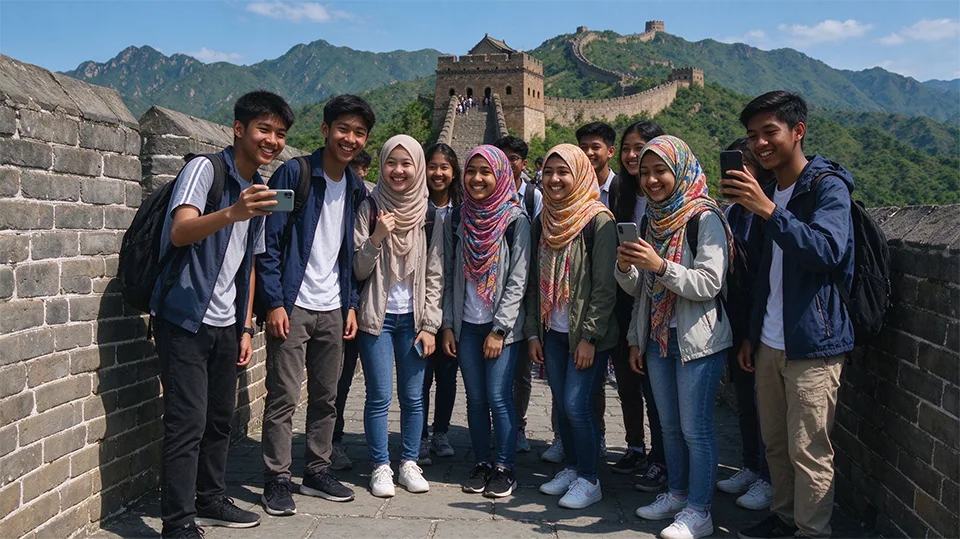
It is the default choice when a school wants a high-impact, curriculum-heavy tour aligned with world history, politics and architecture syllabi. Iconic landmarks such as the Forbidden City, Mutianyu Great Wall, Temple of Heaven and the Summer Palace provide unmatched primary sources for student assignments. Top university visits and student exchange sessions with Beijing high schools are highly sought after by Malaysian independent schools planning pre-university exposure programmes. Halal restaurants are easy to find around the city centre and university zones, and many tourist sites have dedicated prayer rooms or quiet corners that can be arranged in advance. The main decision point for organisers: Beijing involves longer internal travel between sites, and winter or early spring trips can be cold. It also tends to be one of the pricier gateway options compared with Guangzhou or Xiamen.
Xi'an is a hidden favourite for Malaysian groups that love ancient history, Silk Road stories and reliable halal infrastructure.
As the home of the Terracotta Army, Xi'an delivers dramatic, memorable history learning that appeals equally to Chinese-medium and national-stream students. The old city wall, Shaanxi History Museum and Big Wild Goose Pagoda build a cohesive narrative around the Tang Dynasty and inland Silk Road civilisation. A major advantage for Muslim student delegations is the well-established Muslim Quarter, with abundant halal food and local Muslim cultural context. Many Malaysian organisers prefer Xi'an over some other historic cities because local operators here have years of experience serving Muslim school groups. The main trade-off is that there are fewer modern tech industry visits compared with Shenzhen, so Xi'an works best as a history-focused leg of a combined itinerary rather than a standalone STEM tour.
Shanghai and Hangzhou are chosen when schools want to showcase contemporary China, blended with classical Jiangnan beauty.
This route suits groups that balance learning with carefully managed leisure. Shanghai gives students access to finance centres, modern architecture, robotics labs and international university campuses, while Hangzhou provides West Lake, classical gardens and tea culture. It is very popular for combined business, design and photography learning programmes. Halal food is available but less densely distributed than in Guangzhou or Xi'an, so every meal stop must be confirmed weeks ahead. Many Malaysian teachers also note that Shanghai carries strong visual appeal for students, but landmark sites can be extremely crowded during peak holiday periods, which reduces the quality of guided learning time.
Yunnan, centred around Kunming, Dali and Lijiang, appeals to schools looking for cultural diversity, gentle outdoor learning and cooler weather.
This region is excellent for lessons on ethnic minority cultures, biodiversity and sustainable tourism. Malaysian multi-ethnic school groups often respond very well to comparative discussions between China's ethnic communities and Malaysia's own multiracial society. Flights from Kuala Lumpur to Kunming are direct, and the climate is much milder in summer compared with southern China. The practical challenge is that smaller towns in Yunnan have limited halal options, and long driving times between scenic spots can tire student groups. Yunnan works best for schools focused on social studies and environmental education, rather than technology or formal school exchange.
Once you have shortlisted your destination region, the next decision is tour theme. From working with dozens of Malaysian school and homeschool delegations, we can rank the themes by consistent demand, while also outlining the right balance to keep your tour educationally valid.
School-to-school exchange remains the highest priority for most Malaysian organisers, and it is the activity students remember most strongly. But there is a critical distinction between superficial “visit and photo” sessions and genuine exchange. Malaysian teachers consistently report the best outcomes when the host school prepares joint collaborative tasks: paired student discussion groups, shared science experiments, art workshops, or joint cultural presentations. Simple campus walks with a short speech feel underwhelming to students and are hard to justify to parent committees. For mixed-ability Malaysian cohorts, confirm the working language in advance. If half your group struggles with Mandarin, the host school must arrange English-speaking student buddies and facilitators. Many Malaysian schools pair exchange visits with Chinese Mandarin Summer Camp sessions to extend language practice beyond the formal exchange window.
History and heritage study is the second most reliable theme. Malaysian students engage well when learning is not limited to listening to guides recite facts. Successful activities include measuring brick inscriptions on ancient city walls, mapping trade routes from Quanzhou or Xi’an, sketching architectural details at the Forbidden City, and comparing ancient Chinese governance systems with what students learn in their history textbooks. This theme works beautifully for both Chinese-medium and national-stream cohorts, as long as guides use clear English or adjust Mandarin speed according to your group profile.
Technology and industrial study tours are rapidly growing in popularity among Malaysian secondary schools, especially STEM, accounting and business streams. Shenzhen is the undisputed leader here. Students visit smart manufacturing lines, new energy facilities, robotics labs and innovation exhibition halls. They learn about supply chains, digital commerce and startup ecosystems. These visits often spark career conversations among older students. This theme is our China Tech Tours focus, and we recommend it for Form 4, Form 5 and pre-university groups rather than younger students. The key planning note: many industrial sites require advance document submission, fixed arrival windows and no loose bags inside production zones.
Cultural craft and immersive hands-on activities are excellent supporting activities. Malaysian students tend to love calligraphy, paper cutting, tea ceremony, traditional knot making and pottery workshops. These are low-pressure, inclusive activities where quieter students can participate comfortably, regardless of Mandarin ability. They work well as afternoon sessions after heavy morning heritage or exchange visits.
Recreational and entertainment activities have a place, but experienced Malaysian tour coordinators treat them carefully. Theme parks, river cruises and shopping districts boost student morale, but parents and school administrators expect educational value to remain the core. The most successful itineraries we see limit pure entertainment to one half-day or evening per week. When entertainment dominates the schedule, the school struggles to validate the trip’s educational purpose to school boards and parents.
There are also niche themes gaining traction with Malaysian groups. University preview visits are highly valued by pre-university students considering tertiary study in China. Sustainable agriculture and eco-study programmes suit environmental science cohorts. Food culture study, with proper halal framing, can be built into social science lessons, examining food as a marker of migration and cultural identity.
Understanding which specific activities land best will help you shape your day-by-day schedule. Activities that score highest for Malaysian school groups fall into this set: paired student exchange discussion, guided museum inquiry tasks, structured heritage site scavenger hunts with worksheet questions, guided tech factory briefings with Q&A, hands-on craft workshops, structured Mandarin conversation practice, guided ethnic culture sharing sessions and student-led reflection journal time. Activities that are enjoyable but carry less academic weight include city sightseeing cruises, light hiking, traditional performance shows and market walks. These are fine as rewards, but should not form the bulk of the programme. Activities to approach cautiously are crowded evening night markets with loose supervision, long unstructured free shopping time, and sites with no clear curriculum link.
Halal and prayer logistics are make-or-break planning items for Malaysian delegations, and they deserve explicit attention. When you evaluate a proposed itinerary, do not accept generic promises that “halal food can be arranged”. Ask the operator to confirm each restaurant, whether it is halal-certified, whether food is cooked in separate utensils, and what backup options exist if a restaurant is closed. For prayer, identify dedicated prayer rooms at universities, shopping malls and major tourist sites, and build flexible rest time into the schedule for prayer. Xi’an, Guangzhou and Shenzhen have the most mature infrastructure for Muslim student groups. Xiamen and Beijing are manageable with advance planning. In smaller heritage towns and rural zones, packaged halal meals or self-catered arrangements may be required. Many Malaysian organisers also request separate serving times or segregated dining areas to avoid cross-contamination concerns.
Visa and travel rules are another moving piece. Malaysian passport holders enjoy visa-free entry for tourism, but school study tours sometimes involve campus and factory access that falls outside pure leisure travel. Always confirm the latest official entry requirements before confirming bookings, and share the exact programme list with your tour provider so they advise you correctly. Keep all invitation letters from host schools or institutions ready, as immigration officers may request supporting documentation for educational delegations.
We have seen four standard itinerary formats repeatedly chosen by Malaysian schools, and they provide a useful starting point for your decision-making.
Before signing off on any package, run through these five decision questions with your school committee.
The best China study tours for Malaysian schools do not try to show students everything. They select a coherent learning story, match destinations to that story, accommodate the unique cultural and religious needs of Malaysian multi-ethnic students, and build genuine interaction between Malaysian and Chinese learners. Whether your priority is root culture, ancient history, cutting-edge technology or language immersion, the right itinerary will turn a school trip into a memorable learning experience that students can draw on for assignments, university applications and personal growth.
Malaysian interest clusters around five themes, and they are not equally strong.
This is the reason most Malaysian schools travel. The demand is for real classroom contact: sitting in on lessons, paired buddies, joint projects, a shared performance, a football or basketball match, a letter-exchange follow-up.
The value for Malaysian students is specific. For Chinese-stream students, it is the experience of being in a classroom where Mandarin is the medium of instruction at full speed, and the discovery that their own Mandarin is better than they thought. For national-stream students, it is a first encounter with an education culture quite unlike their own.
What makes an exchange fail: a "visit" that is a tour of the campus, a photo, and a gift exchange. Real exchange needs at least half a day, mixed teams, and a task the two groups complete together.
The practical constraint: exchange partners need to be matched by school type, student age and academic level, and they need to be booked months ahead, because Chinese schools' calendars and examination periods are tight. Organisers who promise exchange casually and deliver a campus walk are the reason many Malaysian teachers stop trusting agents.
Beijing, Xi'an, Nanjing, Luoyang and Kaifeng carry the curriculum weight. Malaysian secondary students studying Chinese history, or preparing for Chinese-language examinations, find these cities directly useful.
What works better than monument-visiting: a question to answer at each site. "Why was the wall built on this ridge rather than that one?" "What do the stamps on these city bricks record?" A worksheet turns a photo stop into an hour of genuine observation.
Malaysian demand for tech and industry access has grown sharply, particularly from STEM-focused schools, robotics clubs and pre-university cohorts. The draw is concrete: robotics and AI enterprises in Shenzhen, new energy manufacturing, university laboratories, smart-city operations, drone and e-commerce logistics.
Malaysian students often arrive with a specific comparison in mind - Malaysia's own industrial and tech sector - which makes visits more productive than for groups with no reference point.
For organisers building this kind of itinerary, the range of accessible sites is broader than most expect; our China Tech Tours programme is structured around exactly that geography of hardware, manufacturing and digital economy clusters.
Disneyland Shanghai, Universal Beijing, Chimelong, Happy Valley, e-sports venues, immersive hanfu experiences, night markets, and - for a meaningful minority - game and animation culture.
This theme fills buses. Malaysian students respond to it strongly, and a well-placed entertainment day is legitimate: it is part of how young people experience a country. But it should be a small fraction of the programme. Groups that are 60% theme parks come home having learned very little, and the teachers who recommended the trip are embarrassed.
A workable ratio: one entertainment day per week at most, positioned as the reward after a deliverable.
China is an increasingly realistic higher-education destination for Malaysian students, with scholarship routes, English-taught programmes and recognised qualifications. Campus visits, admissions briefings and meetings with Malaysian students already studying there convert a study tour into a genuine decision-support experience for Form 5 and pre-university students.
Very few Malaysian school trips include this. For the cohort that is about to choose a university, it is the most valuable half-day in the itinerary.
Do Malaysian students need a visa for China?
Malaysian ordinary passport holders currently benefit from visa-free entry for short stays, and the terms have changed more than once in recent years. Confirm the current duration and conditions with the Chinese embassy or an official source shortly before departure rather than relying on last year's rule.
How much Mandarin do Malaysian Chinese-stream students gain?
Their grammar and vocabulary are usually already strong; what they gain is speed, listening tolerance for regional accents, confidence in spontaneous speech, and correction of tone habits. The gain is real but not measurable in the same way as for a beginner.
Which city is best for a first Malaysian school trip?
Guangzhou for access and cost, or Beijing for curriculum weight. Beijing is the stronger educational choice; Guangzhou is the easier first trip.
Can halal food be arranged everywhere?
In Xi'an, Beijing, Guangzhou and Shenzhen, generally yes with planning. In smaller heritage towns and parts of Yunnan, it needs to be confirmed stop by stop. Get it in writing with a menu plan.
Is a school exchange guaranteed?
No honest operator guarantees one until a partner school has confirmed dates. Ask when the partner is confirmed, and be suspicious of a promise made before booking.
When should we travel?
March–April and November for comfort; August–September if the school calendar forces it, with heat discipline and a cooler region. Confirm the partner school's calendar before flights.
How does a China trip compare with Singapore or Japan for value?
China's domestic costs are generally lower, flights are comparable or shorter, and the scale of what can be covered in a week is larger. Japan offers better logistics polish; China offers more curriculum range per day.
If you are ready to refine your plan, the team at PandaStudyTour can customise a full risk-assessed, halal-ready study tour itinerary tailored exactly to your school’s cohort, learning objectives and holiday dates.
