Educational travel is a crowded market. Every year, schools in Europe, North America, Australia and Southeast Asia choose between a dozen plausible destinations: Europe for art and history, East Africa for ecology, Southeast Asia for development studies, Latin America for language immersion.
China has entered that conversation late and, in most schools, incompletely. It tends to appear as an optional extension rather than a first-choice destination - interesting, but difficult; important, but hard to justify to a board, a parent body, or a risk committee.
That framing is now out of date, and the students who have been are the ones making the argument. China offers something most destinations cannot: a single journey that combines a curriculum-relevant civilisation, a live language environment, industrial and technological access, and a scale of internal variety that keeps a group engaged for two or three weeks without repetition.
This article makes that case properly - including the parts where China is a poor fit, because a recommendation that hides the trade-offs is not a recommendation.
The first question a school asks is not "is this interesting" but "what does it replace in the syllabus". China answers that unusually well, and across more subjects than most educators expect.
History and civilisations. Dynastic history, imperial administration, the Silk Road, twentieth-century modernisation. These are not abstractions here; they are buildings, artefacts, excavation sites, and museums with the primary material in the room.
Geography. Karst landscapes, river systems, desertification, urbanisation, the plateau. Field observation of processes students usually only see in diagrams.
Economics and business. Supply chains, manufacturing, e-commerce, cross-border trade, industrial policy. Accessible at a depth that is difficult to arrange in most countries, because the enterprises are willing to host student groups.
Design, art and architecture. Calligraphy, silk, porcelain, garden design, timber-frame construction, contemporary architecture.
Language. Mandarin is the most widely spoken first language in the world and one of the more strategically useful for students entering almost any field.
STEM. University laboratories, robotics and AI enterprises, new energy manufacturing, smart-city infrastructure.
A single well-designed itinerary can carry two or three of these strands simultaneously. That is the practical argument for China: it produces a denser academic return per travel day than most alternatives.
This is the strongest and least arguable case, and it applies to any student who has studied Chinese, however briefly.
Classroom study produces knowledge. Being in the country produces use. The difference shows up in three specific ways.
Listening. Real speech is faster, messier and more regional than any recording. Students who spend three or four weeks in a Chinese city develop tolerance for ordinary-speed speech that classroom audio never builds - because classroom audio is scripted, and real speech is full of hesitation, repair and background noise.
Willingness to speak. A student who has successfully ordered lunch, taken a taxi, asked a stranger for directions and been understood stops treating Mandarin as a school subject and starts treating it as a tool. That shift is the single most predictive factor for whether a student continues the language beyond the following term.
Tone. Tones cannot be learned reliably from a textbook. They are learned by imitation, correction and repetition with a speaker who produces them natively and notices when you do not.
Programmes designed around this - morning classes, afternoon field tasks, evening consolidation - produce more usable Chinese in four weeks than a year of weekly evening classes. Families and schools looking at this structure can see the age bands, study formats and daily rhythm on our Chinese Mandarin Summer Camp page, which is built specifically around the class-plus-application model.
Group leaders know the failure mode: a two-week itinerary that peaks on day four and then becomes a sequence of similar sites.
China makes that failure unlikely, because the internal variety is extreme and the friction of moving between regions is low.
With high-speed rail, students can move from Beijing's imperial centre to Xi'an's archaeological plain in four and a half hours, from Xi'an to Chengdu in three, from Chengdu to the edge of the Tibetan plateau in a morning's drive. Each region has a different cuisine, a different speech pattern, a different economic base, a different landscape.
For a study group, that variety is curriculum. Students comparing regional difference - food, dialect, architecture, industry - are doing comparative analysis without being told they are doing it. That is the most durable form of learning a study tour can produce.
For groups with a technology or industry focus, the variety is equally useful: the concentration of hardware and electronics manufacturing in one region, advanced manufacturing in another, digital economy in a third, gives a group a genuine range of site visits in a single trip. Our China Tech Tours programme is structured around exactly that geography.
Cost is an educational issue, not only a budget issue, because cost determines how many days a group can afford and how much of the country a syllabus can cover.
China's domestic cost base - accommodation, intercity transport, meals, local guiding - is generally lower than Western Europe or North America. International flights are the main expense, and they are comparable to most long-haul destinations.
The practical result: a group that budgets for ten days in a European capital can often fund fourteen days across three Chinese regions, including internal high-speed rail, without upgrading anything. Four extra days on the ground is roughly the difference between a sampler and a study.
This is not an argument that China is cheap. It is an argument that the amount of educational experience per unit of spend is unusually high - which, for a destination this large, is the most consequential economic fact about it.
Access is the hidden variable in educational travel. Many destinations can show students a museum. Far fewer can put a group of undergraduates in a working factory, a university laboratory, or a company briefing room.
In China, that access is comparatively routine, particularly for educational delegations. Enterprises host student groups, universities run visiting programmes, industrial parks maintain reception functions for delegations. A group can spend a morning in a robotics R&D centre and an afternoon comparing it with a textile workshop in an older industrial district.
For students in engineering, business, supply chain, design and public policy, this is the difference between reading a case study and standing inside the case.
The caveat is that access must be arranged in advance, through relationships, with a stated purpose. Groups that arrive expecting to walk into factories are disappointed; groups that plan months ahead get substantive visits.
History teaching relies on reproductions: photographs, scans, reconstructions. In China, students can handle the primary material.
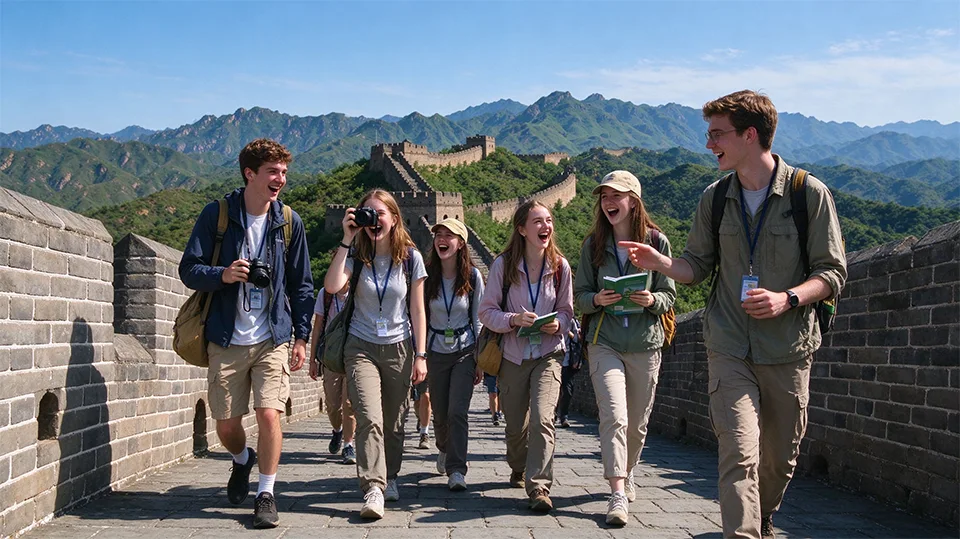
Walking the Great Wall teaches defence logistics in a way no diagram does. Reading the inscriptions on Ming city bricks - each stamped with the producing kiln and the responsible official - teaches quality assurance in a fifteenth-century bureaucracy. Standing above the Terracotta Army pits teaches the scale of imperial ambition more efficiently than any lecture. Sitting in a Ming-dynasty hall at a temple teaches timber construction because the joinery is visible above your head.
The pedagogical point: material evidence produces questions that slides do not. Students who have seen the object ask better questions about it afterwards, and that includes in exams.
Risk assessment is the gatekeeper of every school trip, and it is where China is frequently misjudged.
The practical picture for a supervised group:
The genuine risk factors for groups are different from the ones people expect: heat in summer, traffic, altitude on the plateau, dietary adjustment, and the emotional load of a group far from home. All of these are manageable with planning, and all are worse in programmes that over-schedule.
Group leaders should ask a prospective operator for the actual risk documentation: ratios by time of day, insurance terms, medical escalation procedure, emergency contact protocol, and the process for a student who cannot continue. An operator who cannot produce these in writing has not built them.
Study tours compete for space in a crowded academic calendar, so the justification often comes down to output. China produces unusually portable output:
The programmes that produce these are the ones that build assessment into the itinerary from the start. Programmes that retrofit assessment from a folder of photographs produce a certificate of attendance, which is worth very little.
Four situations where another destination is the better choice.
Very short trips. Under eight days, internal transport and settling consume too much of the programme. China rewards time; a seven-day visit across three cities produces exhaustion and a photo album.
Very young groups. Under ten or eleven, the pace, food, heat and language environment demand a level of supervision that most operators will not promise in writing. A day programme with parent accompaniment is the right format at that age, not a fourteen-day multi-city tour.
Groups without an academic purpose. If the trip is essentially a holiday with optional lectures, the logistical cost of China is not repaid. A nearer destination does the same job for less.
Groups that cannot prepare in advance. China rewards pre-departure work: language basics, background reading, research questions. A group that arrives with no preparation gets a good tourist experience and a weak study tour.
Stated plainly: China is not a destination you can improvise. It is a destination that repays planning, and that is both its limitation and its value.
A short checklist, applicable to any operator.
A programme that answers all eight is a study tour. One that answers three is a tour with a school logo on it.
At what age is a China study tour appropriate? Twelve and above for supervised multi-city programmes; from about eleven for residential formats with high staffing density. Under eleven, a day programme with parent accompaniment is more appropriate.
How long should a study tour be? Ten to fourteen days is the practical minimum for a multi-city programme with an academic purpose. Four weeks allows genuine depth, including language work.
Do students need to speak Chinese? No. Beginner-friendly programmes use bilingual staff, translation tools and prepared phrase sets. Students with prior study gain disproportionately, because the environment converts their knowledge into use.
Is China safe for student groups? Violent crime against visitors is rare and independent movement is generally unremarkable. The real risks for groups are heat, traffic, altitude and emotional adjustment - all manageable with planning. Ask for the risk documentation rather than an assurance.
Will a study tour count for academic credit? Only if it has pre-departure work, defined objectives per location, field deliverables and a summative assessment. Many programmes can support credit; few are designed for it. Ask before booking.
How much Mandarin will students learn in two weeks? For a beginner, enough to manage transactions and simple exchanges, plus improved pronunciation and 30–60 recognised characters. For a student with prior study, a noticeable jump in listening tolerance and willingness to speak.
What is the best season? Spring (April–May) and autumn (September–October) for most regions. Summer suits high-altitude programmes and language camps. Winter is ideal for the northeast and for crowd avoidance elsewhere.
International students choose China for study tours because the country converts travel days into learning at a rate few destinations match: a curriculum-relevant civilisation with primary material in place, a live language environment, industrial and institutional access that is genuinely arrangeable, internal variety large enough to sustain a three-week programme, and a cost base that buys more days on the ground.
The condition is planning. Defined objectives per city, field deliverables, staffing and risk documentation, pre-departure preparation, and honest scheduling. Without those, China is an impressive holiday. With them, it is one of the most effective classrooms a school can put a student inside.
If you are building a programme, our PandaStudyTour team designs study itineraries around a stated academic objective rather than a list of sights - language immersion, heritage fieldwork, technology and industry access, and multi-region comparison - and we are willing to tell you when a different destination would serve your group better.
