Destinations: Reed Flute Cave, Li River, Huangguoshu, Zhijin Cave
Few places on Earth show geology as clearly as the karst of southern China. This field study turns the landscape itself into a laboratory: from the dreamlike limestone towers of Guilin, mirrored in the Li River, through vast cave systems and a 2,200-metre waterfall, to the terraced hillsides where people have farmed the steep stone slopes for centuries. Each day pairs a dramatic site with a geologist-guided lesson in how it formed - rainwater dissolving limestone over hundreds of millions of years. By the end, you will see every peak, cave and spring as a chapter of deep time, and understand why the South China Karst is a UNESCO World Heritage landscape.
Theme: Read the planet in limestone - tower karst, caves, underground rivers, waterfalls and terrace ecosystems
Pace: Moderate, field-study focused - ideal for geography, earth-science and environmental-study groups, plus curious adult travellers
Gateways: Guilin (arrive) / Guiyang (depart), connected by the Guiguang high-speed rail line
Field-study modules (tailored to your group's level): karst landform classification · limestone sedimentology and fossil identification · cave formation and speleothem growth · karst hydrology and groundwater resources · terrace agriculture and human-land adaptation · geotourism and conservation ethics. English field notebooks, worksheets and, for university groups, academic-level discussion can be arranged.
Practical information
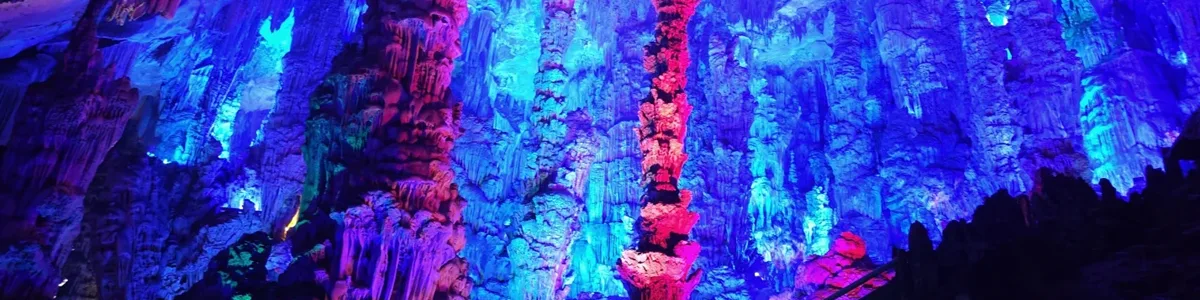
Day 1 - Arrival in Guilin: Your First Karst Cave. After transfer and check-in, visit the Reed Flute Cave, a lit-up karst cavern where stalactites and stalagmites illustrate, in a single underground chamber, how water sculpts stone. Your geologist-guide opens the programme here: how limestone was laid down as tropical sea sediment hundreds of millions of years ago, and how it has been dissolving ever since. An evening walk along the Li River foreshadows the towers that await.
Day 2 - The Li River: Tower Karst from the Water. Board a Li River cruise south to Yangshuo - the most celebrated karst landscape on Earth. From the deck you observe the cone and tower peaks rising straight from the floodplain: the very view that has shaped Chinese painting for a thousand years, and a textbook example of tower karst. On shore stops, you examine the limestone cliffs, river terraces and bedding planes that show the river at work. In the afternoon, cycle or walk Yangshuo's "Ten-Mile Gallery" karst valley on foot, reading the peaks as you go.
Day 3 - Under the Surface: Silver Cave and Dragon's Backbone Terraces. Morning visit to Silver Cave, a multi-level cave through which an underground stream still flows - you see the transition from surface river to underground river in real time. Then drive to the Longji (Dragon's Backbone) Rice Terraces, carved by Zhuang and Yao communities into the steep karst hillsides. The field lesson turns human: how people farm thin limestone soils, how terraces manage water and erosion, and how karst ecology sustains a distinctive mountain agriculture. Sunset over the layered terraces.
Day 4 - Terraces to the Plateau. Dawn over the terraces before breakfast, then drive back to Guilin and board the high-speed rail west to Guiyang (about 2.5–3 hours), crossing from the limestone lowlands of Guangxi onto the Guizhou Plateau. On arrival, settle in and prepare for the Guizhou half of the study.
Day 5 - Huangguoshu: Karst in Motion. A full day at Huangguoshu Waterfall - Asia's largest (77.8 m high, 101 m wide) - and the surrounding cascade system, including the Tianxingqiao karst garden and the trail behind the falling water. The theme today is karst hydrology: how water moves across, over and through the limestone, why waterfalls appear here, and how caves and rivers exchange water in a landscape where almost nothing stays on the surface.
Day 6 - Zhijin Cave: The Underground Cathedral. Visit Zhijin Cave, one of the largest and most beautifully decorated caves in Asia - kilometres of chambers, flowstones, stalagmites and a still-active underground river. Here you learn cave dating and growth rates (a stalagmite adds about a centimetre per century), cave ecosystems in permanent darkness, and the conservation challenges of a fragile show cave. Return to Guiyang in the evening.
Day 7 - Synthesis & Departure. A final morning discussion connecting the week: limestone sea, tower peaks, underground rivers, waterfalls, terraces and minority cultures - all expressions of one karst system, and all part of the water, livelihoods and future of southern China. Transfer to Guiyang airport for your onward journey.