Kung fu occupies a strange position in the Western imagination: half cinema, half wellness trend, and almost never the ordinary practice it actually is. The best reason to bring students to China for it is not to learn to fight. It is to encounter a practice that requires patience, repetition, respect and physical humility - qualities that are unusually difficult to teach in a classroom and unusually easy to encounter in a training hall.
This article sets out how a serious kung fu and traditional culture programme is built: where to train, how training should be structured for teenagers, what the surrounding cultural components should be, and how to avoid the commercialised versions of this experience that teach nothing.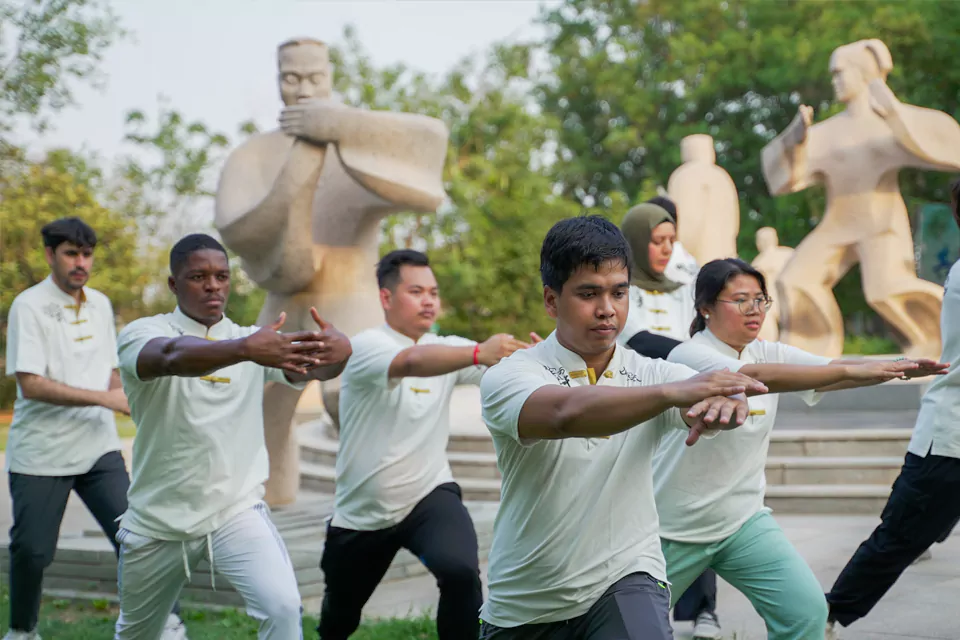
Parents often imagine a week of choreographed sequences and a photograph in a uniform. The reality, done properly, is different and better.
Training begins with stance and posture - a physically demanding and seemingly endless phase that students find tedious until they discover it is the foundation of everything. It progresses through basic movements repeated until they become automatic, then short forms, then partner drills at controlled intensity. Advanced sessions may include weapon forms, but only with trained supervision and appropriate equipment.
What students gain is not combat capability. It is: physical control, capacity for repetition, an understanding of how competence is built over years rather than weeks, and a working relationship with an instructor whose authority derives from practice rather than from position.
That last point is the most valuable and the least replicable elsewhere.
Shaolin Temple area, Henan. The most recognisable location, with the widest range of training facilities and instructor availability. Caveats: the commercial zone around the temple is heavily tourist-oriented, and quality varies enormously between schools. Selection matters far more than location. A genuine training centre with long-term students, a structured curriculum and resident instructors is very different from a venue that runs two-hour tourist classes.
Wudang Mountains, Hubei. Associated with internal arts - taiji, bagua, xingyi. Quieter, more contemplative, more suited to students interested in slow practice and philosophy. Fewer options, higher quality on average.
Emei and Sichuan centres. Smaller programmes with strong local character, often combined naturally with Chengdu's cultural itinerary.
Urban training halls in Beijing and Shanghai. Professional facilities with qualified instructors, useful for short components within a broader itinerary where travel to a mountain centre is impractical.
For school groups, the mountain-centre model works best: immersion, a residential rhythm, and a clear separation from ordinary tourist life.
A programme that runs four hours of training daily will produce injuries and resentment. A workable schedule:
Morning session (90 minutes). Warm-up, stance and posture work, basic movements, then new material when students are fresh.
Late afternoon session (60–90 minutes). Review, partner drills at controlled intensity, forms practice, and conditioning.
Rest and cultural block in the middle of the day. Heat management in summer is essential; training in the early afternoon in Henan in July is unwise.
Progression should be visible: students learn a short form across the programme and perform it at the end. Performance is the output — public, accountable, and genuinely satisfying.
Instructors should be briefed on the group's age, fitness and any injuries. Students with medical conditions must be declared in advance. Sparring should be excluded for minors in school groups.
A kung fu programme that fills the rest of the day with generic tourism wastes its setting. The cultural components should connect to the training.
Tea culture. Brewing, tasting and the etiquette of serving. A natural partner to martial practice: both are about attention, patience and the discipline of small movements.
Calligraphy and brush practice. Posture, breath and repetition - the same principles in a different medium. Students often find the connection immediately.
Traditional medicine concepts. Not as a substitute for medicine, but as a cultural system with its own logic: meridian theory, herbal practice, the relationship between movement and health. Present it as history and philosophy, with clear framing.
Craft. Paper cutting, knot tying, porcelain painting, drum and percussion.
Heritage sites relevant to the tradition. Shaolin Temple itself, the Pagoda Forest, Song Mountain, and - for a broader historical frame - the Buddhist and Daoist institutions that shaped these practices.
Food. Regional cuisine is part of the experience. Henan and Hubei cooking are less internationally known than Sichuan or Cantonese, and therefore more genuinely novel.
Days 1–2: Arrival, orientation, foundation. Safety briefing, uniform and equipment, first training sessions on stance and posture, introduction to the tradition's history.
Days 3–6: Core training block. Twice-daily sessions, progressive form instruction, tea and calligraphy sessions interleaved, evening cultural talks.
Day 7: Heritage and rest. Shaolin Temple and environs, or a mountain walk. Deliberately light.
Days 8–9: Intensive and integration. Longer training sessions, partner work, cultural craft workshops, and preparation for the final performance.
Day 10: Cultural excursion. A secondary heritage site or a city day - Luoyang's grottoes, or Kaifeng's Song-dynasty heritage, depending on location.
Day 11: Performance and ceremony. Students perform the form learned, receive feedback, participate in a closing ceremony with instructors.
Day 12: Departure.
Two errors are common in this category.
The first is orientalism: presenting kung fu as mystical, spiritual or exotic, with talk of energy and inner power substituting for training. Students see through this and learn nothing. The correct framing is practical: this is a physical discipline, developed over centuries, with a coherent internal logic, taught by people who have devoted their lives to it.
The second is overclaiming: promising self-defence competence after two weeks. Two weeks produces foundations, fitness and appreciation. It does not produce a fighter. Being clear about that protects both credibility and safety.
On safety: warm-up and cool-down must be non-negotiable; training surfaces should be appropriate; instructors must be qualified and first-aid trained; ratios should be low; and any student with a pre-existing injury must be cleared and accommodated.
Is prior martial arts experience required?
No. Beginners are well served by foundation training. Students with experience should be placed in a separate group.
Is this suitable for girls' groups?
Entirely. Mixed and single-sex groups are both common, and female instructors are available.
What is the physical demand?
Moderate to high. Students should arrive with reasonable fitness and be prepared for daily activity in warm conditions.
Can the programme be combined with other cities?
Yes. Henan combines naturally with Xi'an by high-speed rail, producing a heritage-focused itinerary.
A kung fu programme is valuable when it is treated as an encounter with a serious practice rather than a themed holiday. That means daily training, qualified instructors, visible progression, and cultural components chosen to illuminate rather than decorate.
PandaStudyTour designs martial arts and traditional culture programmes with training centres selected for quality rather than convenience, and a performance outcome required from every group. See related designs in the China Summer Camp Insights hub, or contact us to shape a programme around a specific tradition.
