Most student travel is transactional. A group arrives, visits, photographs, departs, and the connection ends at the airport. A sister school exchange is structurally different: it creates an institutional relationship that persists after the students go home, produces repeat contact between cohorts, and turns a single summer into the beginning of a multi-year partnership.
Adding an exchange to a summer camp changes both. The camp gains a social core and an authentic classroom context; the exchange gains the cultural and academic programming that a formal partnership often lacks on its own. This article explains how a combined programme is designed, how partner schools are matched, and what schools should expect in practice.
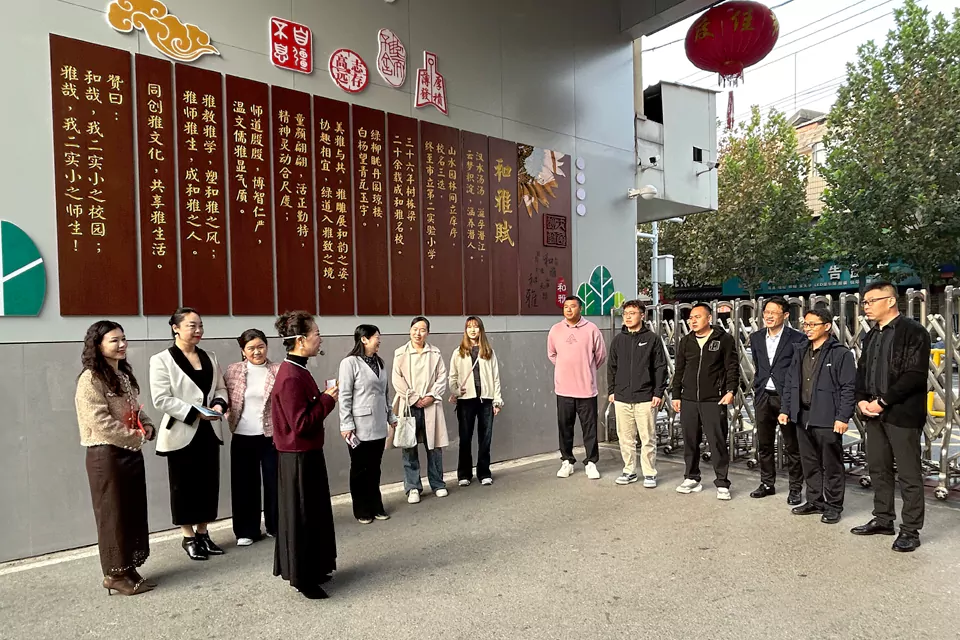
Three things, each substantial.
A peer group rather than an audience. In a camp without a partner school, Chinese students appear as performers or hosts. In an exchange, they become classmates with shared tasks and mutual obligations. Teenagers behave differently when they must collaborate rather than observe.
Institutional continuity. A matched school relationship can be renewed annually, extended into teacher exchange, and referenced in both schools' international strategy. That continuity is what distinguishes a partnership from a trip.
Authentic classroom immersion. Sitting in a real class, with a real timetable, taught in Chinese, is one of the most memorable experiences available to a visiting student. It is also humbling in a productive way.
A good match is not based on prestige. It is based on four compatibility dimensions.
Age and stage. Primary with primary, lower secondary with lower secondary, upper secondary with upper secondary. Cross-stage pairings create awkwardness in shared activities.
Curriculum orientation. A school with a strong STEM focus pairs well with a science-oriented Chinese school; a humanities school with a school that emphasises language and culture; an arts school with a school that has genuine arts provision.
Language capacity. Chinese partner schools vary in English provision. Where English is limited, we build in bilingual facilitation and structure activities that do not depend on fluency - sport, art, music, coding, joint making.
Practical accessibility. A school in the city the group is already visiting, or within a reasonable transfer, avoids wasting a day.
We present candidate profiles with genuine information — size, stage, curriculum emphasis, prior exchange experience, facilities - and schools choose. We do not assign partners without consultation.
Option A - exchange-anchored camp (10–14 days). Two to four days at the partner school at the centre of the programme, with the remainder of the itinerary built around it: heritage visits that support the joint project theme, cultural workshops, and city exploration. The most coherent design.
Option B - camp with an exchange day (8–10 days). A broader multi-city itinerary with one substantial day at the partner school, including a shared class, a joint activity and a buddy session. Suitable where the school relationship is new and being tested.
Option C - parallel programme (12–16 days). The visiting group and the partner school's students work on a joint project across several sessions, with a shared final presentation. More demanding to organise and by far the strongest educational outcome.
Option D - reciprocal model. The Chinese partner visits your school in a different season, creating a genuine two-way exchange. Requires a longer planning horizon and commitment on both sides.
The most common failure in school exchanges is a joint activity that has no task. Students are placed in a room, introductions are made, photographs are taken, and everyone is relieved when it ends.
A joint activity needs a problem, a division of labour and an output.
Problem. A design challenge, a research question, a performance to build, a documentary to make, a debate to hold, a robotics challenge, a mapping exercise of both neighbourhoods, a comparative study of food culture.
Division of labour. Mixed teams, with each member holding a defined role. Avoid separating the visiting students into one group and the hosts into another.
Output. Something presented at the end, to an audience that includes teachers from both schools.
Language difference is useful rather than problematic here. Teams that must communicate across a language barrier develop strategies — drawing, translation apps, simplified speech — that are themselves a learning outcome.
Buddy pairing is the mechanism through which individual students form genuine relationships. It fails when it is ceremonial and succeeds when it is structured.
Practically: pair before arrival, with a short introduction exchange. Give each pair a specific task per day rather than simply "spend time together." Include a shared meal in a small group. Provide a defined communication channel for the period after the trip, and expect it to be used. Many partnerships that endure do so because a handful of buddy pairs kept talking.
Term dates. Chinese school terms differ from many international calendars. Summer exchanges usually occur during holidays, when campuses are empty and students are on break - meaning the exchange must be scheduled with students who are willing to attend. Some partner schools arrange voluntary holiday programmes; others cannot.
Permissions and safeguarding. Chinese schools have their own safeguarding and photography policies. Consent for images of Chinese students must be obtained through the school, and should be discussed early.
Language in classrooms. A visiting student who cannot follow a lesson in Chinese will need a buddy translating and modified expectations. This should be framed as immersion, not assessment.
Institutional agreements. A simple memorandum of understanding, in both languages, covering the scope of exchange, contact points, safeguarding expectations and data and image consent, prevents misunderstandings later. Our China Sister School Exchange Tour service covers the standalone version of this arrangement.
A partnership should be reviewed, not assumed. Practical indicators: whether the joint project was completed; whether buddy pairs remained in contact; whether teachers exchanged anything of value; whether both schools wish to renew; and whether students can articulate what they learned about the other system.
Can a school start with a camp and add exchange later?
Yes, and this is the most common path. A first visit establishes trust; the partnership is formalised afterwards.
How long does matching take?
Four to eight weeks typically, depending on whether the school has specific requirements.
Do the Chinese students speak English?
Variable. We assess this during matching and design activities accordingly.
Is a memorandum of understanding required?
Not by us, but it is strongly recommended and improves durability.
A summer camp gives students a fortnight in China. A sister school exchange gives them counterparts in it. Combined, the two produce something that neither achieves alone: a structured, sustained relationship between institutions, carried by students who have worked together rather than merely met.
PandaStudyTour matches schools carefully, designs joint activities with real tasks and outputs, and maintains the bilingual coordination that makes partnerships function after the visit ends. Explore the China Sister School Exchange Tour for the standalone programme, or read more in the China Summer Camp Insights hub.
