Lantern Festival in China is the brightest night of the year - a celebration of light, family and spring that closes the two-week-long Chinese New Year season in a blaze of colour. For international travellers, it is also one of the most visually spectacular moments to be in the country: ancient streets hung with silk lanterns, rivers floating with glowing paper boats, fireworks bursting over city walls, and crowds of families walking together under a full moon. If you have ever dreamed of seeing China at its most magical, this is the night to plan around.
The Lantern Festival (元宵节,Yuánxiāo Jié) falls on the 15th day of the first month of the Chinese lunar calendar - the first full moon of the new year. In 2026, it will be celebrated on March 3. Because the date follows the moon, not the Gregorian calendar, it drifts each year between early February and early March.
In Chinese tradition, the festival is the grand finale of the Spring Festival (Chinese New Year). Where New Year's Eve is a family dinner at home, the Lantern Festival is the moment everyone steps outside together - to see the city transformed by lanterns and to mark the return of spring. The full moon on this night is the first of the year, and for thousands of years Chinese families have believed that walking out under it together brings good luck and a healthy year ahead.
Like most great Chinese festivals, the Lantern Festival has a legend attached to it. The most famous tells of a palace maid named Yuanxiao who, unable to visit her ageing parents because she served the emperor year-round, fell into despair. A clever adviser to the emperor devised a plan: he spread word through the capital that the Fire God would descend on the 15th day to burn the city, and the only way to avoid disaster was for every household to hang red lanterns, set off firecrackers and light fires that night - making the whole city appear to be burning.
The emperor ordered it done. The streets blazed with lanterns and fire, and in the chaos Yuanxiao slipped out to reunite with her family. The city survived, the people celebrated, and the custom was repeated every year after. It is a story that captures everything the festival means: light against darkness, cleverness, family, and the joy of a whole community celebrating together.
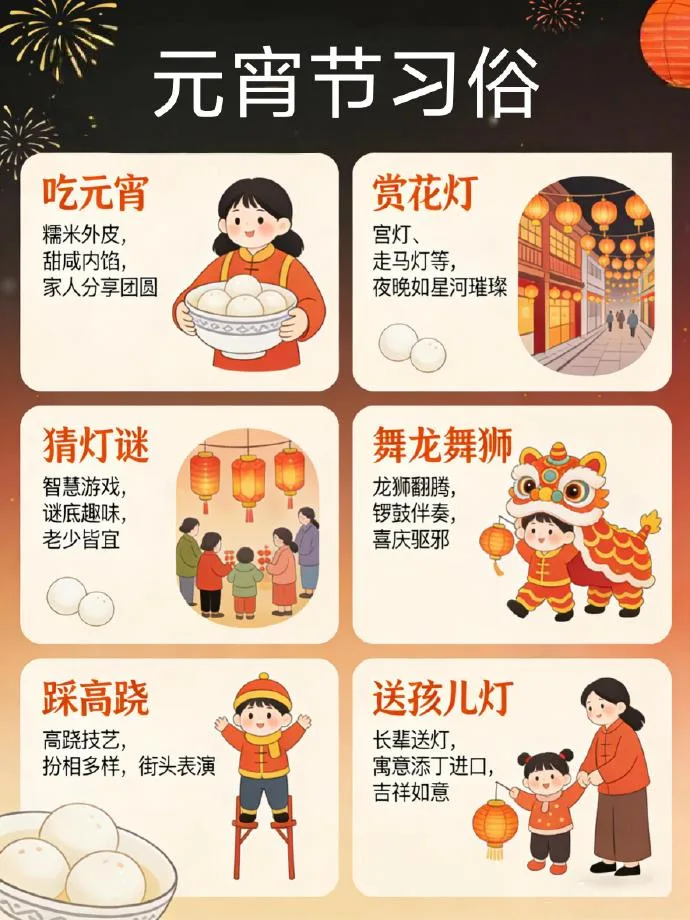
Every region of China celebrates a little differently, but five traditions run through them all:
Admiring lantern displays (赏花灯). This is the heart of the festival. Cities build enormous themed lantern parks - some displays are so large they cover entire lakefronts with dragons, pagodas, zodiac animals and characters from legends, all glowing in intricate handmade detail. In smaller towns, families hang simple red lanterns from windows, balconies and trees.
Solving lantern riddles (猜灯谜). Riddles are written on slips of paper and hung from lanterns. Anyone can pull one down and try to answer; guess correctly and you win a small prize. It is a beloved street game for all ages - and a wonderful, low-pressure way for visitors to practise a little Chinese.
Eating tangyuan (吃元宵 / 汤圆). The festival's food is a round glutinous-rice ball - white, soft and served in sweet soup, filled with sesame, red bean or peanut paste. Their roundness symbolises family unity and togetherness. Northern China calls them yuanxiao, the south calls them tangyuan — same idea, slightly different texture. Making them by hand with a local family is one of the simplest, tastiest cultural experiences available anywhere in China.
Dragon and lion dances (舞龙舞狮). Teams of acrobats perform the lion dance through the streets while long dragon puppets - sometimes dozens of performers long - weave and twist to drums and cymbals. In many places the dragon's eyes are lit for the first time this night.
Releasing lanterns and fireworks. In riverside cities, families launch glowing paper river lanterns carrying wishes. In more rural or coastal areas, sky lanterns rise into the night like orange stars. Fireworks crackle across every city - a final loud, joyful goodbye to the New Year season.
Not all lantern displays are equal. If you are planning a trip around the festival, these are the experiences worth travelling for:
Zigong, Sichuan - the lantern capital of the world. Zigong's lantern festival is China's most famous and its lantern-making craft is a national intangible cultural heritage. The displays are genuinely spectacular: huge, mechanically animated scenes built by master artisans. If you can only visit one place for the festival, choose Zigong - many international tour groups combine it with Chengdu's pandas and the Sichuan food trail.
Xi'an - the ancient capital in lantern light. Xi'an's city wall and the Tang-dynasty-style 大唐不夜城 (Great Tang All Day Mall) district glow with thousands of lanterns, and the ancient city looks its most cinematic. A Lantern Festival visit pairs perfectly with the Terracotta Warriors, the Muslim Quarter food streets and a Qin or Han dynasty cultural experience.
Nanjing - the Qinhuai River lantern fair. Nanjing's Qinhuai lantern fair has run for over 1,700 years, making it one of the oldest lantern festivals in the world. Boats glide along the river past lantern-lit pavilions — a scene straight out of classical Chinese painting.
Shanghai - Yu Garden. The old-town Yu Garden area transforms into a lantern wonderland every year, with the 2026 displays themed around the zodiac year. It is easily reached from downtown and a perfect evening stop.
Beijing - the palace and temple fairs. Beijing lights up its hutongs, temple fairs and parks; the festive atmosphere combines with everything else the capital offers — the Great Wall, Forbidden City and hutongs.
For student groups and educational tours, the Lantern Festival is one of the best moments of the Chinese calendar to travel — not only for the sights, but for what can be learned. A well-designed study programme around the festival can include:
These are exactly the kind of immersive experiences PandaStudyTour builds into custom China itineraries - cultural learning that does not feel like a lecture, because the whole city is the classroom.
The Lantern Festival is the answer to a question many first-time visitors ask: what is China like when it is truly celebrating? It is family streets under paper light, children holding glowing rabbit lanterns, grandmothers selling warm tangyuan from steaming carts, dragons twisting through narrow alleys, and a full moon rising over it all. It is old China and modern China at once - and it happens only once a year.
PandaStudyTour specialises in designing China tours for international travellers and study groups, and the Lantern Festival season is one of our favourite times to host guests. We can arrange festival-focused itineraries - lantern workshops, riddle games, tangyuan classes, night walks through the best displays, and the great sights around them - in Beijing, Xi'an, Chengdu, Shanghai, Nanjing or Zigong. Every programme is tailored to your dates, your group and your interests.
If you would like to celebrate the Lantern Festival in China, contact us with your travel dates and group size, and we will build a lantern-lit itinerary around you. The brightest night of the Chinese year is waiting.
